-
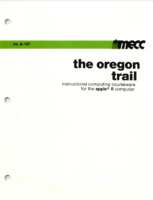
Instruction manual for the video game "The Oregon Trail" developed by the Minnesota Educational Computing Consortium (MECC). The manual contains instructions for playing the game, as well as additional guidance for teachers to help incorporate the game's content in an educational setting.
Minnesota Educational Computing Consortium
-
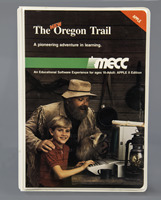
As the longest-published, most successful educational game of all time, The Oregon Trail has blazed a path for the use of video games in learning.
Three student teachers, Don Rawitsch, Bill Heinemann, and Paul Dillenberger, created The Oregon Trail in 1971 to help Minnesota schoolchildren learn American History. First programmed on a primitive teletype printer, the game challenged students to assume the role of Western settlers crossing the continent on the way to the Pacific coast. Players had to choose which items to bring, how fast to travel, and what to do when food ran low or disease struck.
In the 1970s and 1980s, when computing access was rare, The Oregon Trail not only instructed players in American history but also introduced them to computers. The more than 65 million copies of the game that have been sold testify to the game’s appealing story and fun play.
Minnesota Educational Computing Consortium
-
This paperback volume, developed by the Texas Instruments Learning Center, is an introduction to using a handheld electronic calculator (particularly a TI-30 or SR-40) to do mathematics.
Texas Instruments
-
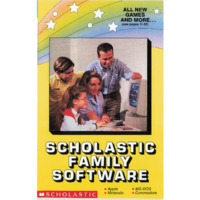
This magazine advertises computer software programs designed for educational purposes for a range of age groups.
Scholastic Corporation
-
The Learning Company's Reader Rabbit manual for the Atari 8-bit, Apple II series and IBM-PC computers.
The Learning Company
-
Frustrated with early education software, Leslie Grimm wanted games to encourage students, not punish them for wrong answers. Enter Reader Rabbit, an upbeat language teacher she designed in 1984 for software publisher The Learning Company. With this animated companion, players gained confidence through memory game matchups and word scrambles. With multiple sequels and a 2018 installment, the franchise supports new generations of alphabet learners.
The Learning Company
-
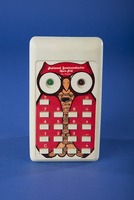
This electronic game tests children on the basic operations of arithmetic. It has an off-white plastic case, and a paper sticker attached under the keyboard and display. The sticker is decorated with a drawing of an owl. The device has eighteen rectangular plastic keys. These include ten digit keys, a decimal point key, a clear key, four function keys, a total key and a question mark key. The on/off switch is at the center of the top row of keys. The display consists of two lights that serve as eyes for the owl, one green and the other red.
Children playing the game entered both a problem and their answer to it. If the answer was correct, the green light flashed reinforcement. If not, the red eye lit up.
According to a trademark registration filed by National Semiconductor Corporation in September 1977 and registered August 14, 1979, the company first used the term Quiz Kid in commerce in April 1975. It was introduced at the Consumer Electronics Show held in Chicago in June 1975. The company sold a similar toy in its Novus line of calculators as the Novus Quiz Kid. An advertisement published in The New York Times just before Christmas in 1975 proclaimed “the Novus ‘Quiz Kid’ might just make a Whiz Kid out of Jr.” The toy sold for $15. An article from May 1976 indicated that by then roughly 600,000 of the toys had been shipped. Advertisements for the toy appeared at least as late as 1981.
National Semiconductor
-
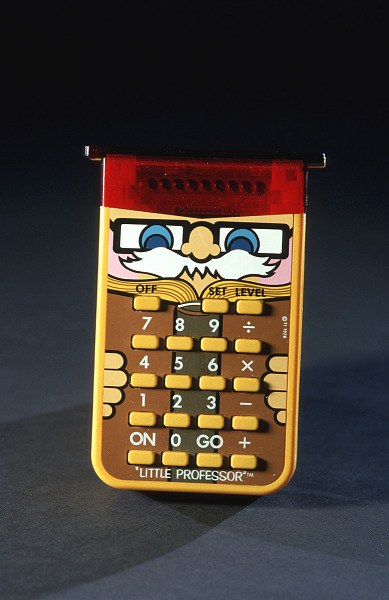
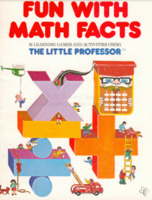
Introduced in mid-1976, the Little Professor is a non-printing electronic calculator modified to present simple arithmetic problems. A correct answer prompts another problem on the eight-digit display. An error delivers the message, "EEE." The colorful keyboard shows a professor with whiskers and glasses. The red light-emitting diode screen, in combination with the top of the instrument, looks like a mortar board.
This example has buttons that allow one to set the level of problems, as well as an on/off button on the front rather than the side of the machine. These features were introduced in a version of the machine made from 1978 onward.
Texas Instruments
-
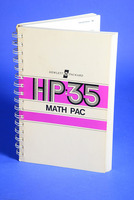
This spiral-bound notebook describes "sequence routines" that could be used to solve mathematical problems on an HP-35 electronic calculator. Topics ranged from arithemetic and swapping numbers to conversions from one system of measurement to another to problems in number theory, algebra trigonomety, geometry, statistics, and finance. According to the volume, most of the sequences were contributed by Mr. Lee Skinner of Albuquerque, New Mexico, a prolific HP-35 user.
Hewlett-Packard
-
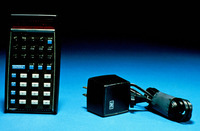
The HP-35 was the first handheld electronic calculator to compute all the functions represented on a slide rule. It has a black plastic case and a total of thirty-five square or rectangular plastic keys. These include ten digit keys, a decimal point key, and a pi key, all colored tan. In addition there are four arithmetic function left of the digit keys, a relatively long enter key, a change sign key, and enter exponent key, a clear x key, and a clear key, all in blue. Additional black keys are for powers, logs to base ten, natural logs, exponents, square roots, trigonometric functions (sine, cosine, tangent and the inverses of these), simple inverses, exchange, roll down, store, and recall. Above the keys is an on/off switch. There is no hole next to the switch to indicate that the display is on, as there was in the very first HP-35 calculators. Behind the switch is a red LED display that shows results. Numbers with absolute value between one hundredth and 10 billion are given in decimal form. Smaller or larger ones appear in scientific notation, with the appropriate power of ten occupying the three rightmost digit places (two for digits, one for a sign). The negative sign for the result, if needed, is at the far left.
Hewlett-Packard
-
Casio Computer Company introduced its fx-7000G graphing calculator in 1985. By 1989, when this monograph was published, other graphing calculators were available, not only from Casio, but from Sharp and Hewlett-Packard. However, because of its low cost, relatively large viewing screen, versatility, and ease of operation, the authors of the manual chose to focus on use of the Casio fx-7000G. The detailed text also describes basic operations of the calculator, graphical solutions to equations, a variety of functions, and applications in modeling in statistics. It was distributed by the Michigan Section of the National Council of Teachers of Mathematics.
Michigan Council of Teachers of Mathematics
-
A manual bundled with Texas Instruments' "Little Professor" calculator. It contains operating instructions for using the calculator, as well as a number of math activities designed to accompany its various instructional modes.
Texas Instruments
-
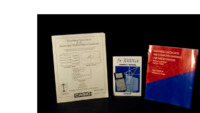
This documentation for Dr. Logo (software by Digital Research, Inc.) includes a reference manual, command summary guide, tutorial, release notes, and system disks.
Dr. Logo is proprietary computer programming software originally designed to teach children how to use computers. The software is conversational and is pre-programmed to understand two hundred one-word commands. The user adds other commands as needed. Dr. Logo may be used to draw pictures, create graphic designs, play word games, record names or numbers, and chart figures.
Digital Research
-
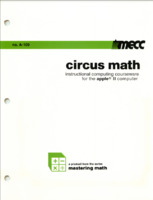
Instruction manual for the arithmetic learning video game "Circus Math" developed by the Minnesota Educational Computing Consortium (MECC). The manual contains instructions on how to play the game, as well as guidance for teachers on how to pair the game's different difficulty levels for appropriate student learning levels.
Minnesota Educational Computing Consortium