-
 Postcard from Henry Griffin to Gordon and Jenni Griffin, Paris, France, October 8, 1981
 Postcard from Henry Griffin to his brother and sister-in-law, Gordon and Jenni Griffin, in Princeton, New Jersey, October 8, 1981. The image on the front of the postcard is an aerial view of Notre Dame in Paris. Henry Griffin discusses his walking tour of Paris and an unsuccessful pickpocketing attempt.
-
 Postcard from Henry Griffin to Gordon and Jenni Griffin, Geneva, Switzerland, September 8, 1981
 Postcard from Henry Griffin to his brother and sister-in-law in Princeton, New Jersey on September 8, 1981. The image on the front of the postcard depicts La Rade, the waterfront in Geneva, Switzerland. Henry Griffin discusses his trip to Geneva for work and living in Aix-en-Provence.
-
 Postcard from Henry Griffin to Gordon and Sallie Griffin, Aix-en-Provence, France, August 31, 1981
 Postcard from Henry Griffin to his parents, Gordon and Sallie Griffin, in Princeton, New Jersey on August 31, 1981. The image on the postcard depicts the cloister and clock tower of the Cathédrale St. Saveur in Aix-en-Provence, France. Henry Griffin discusses the French classes he is taking and the cathedral.
-
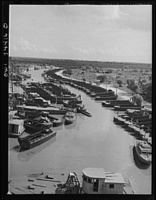 John Vachon worked as a filing clerk for the Farm Security Administration (FSA) before being recruited by Roy Styker to join a small team of photographers employeed to document the conditions of poor, rural areas in the United States. His photographs taken in New Orleans are a mix of street portraiture and shots of working life near the Port of New Orleans.
-
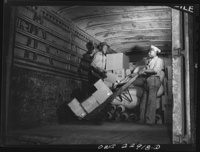 John Vachon worked as a filing clerk for the Farm Security Administration (FSA) before being recruited by Roy Styker to join a small team of photographers employeed to document the conditions of poor, rural areas in the United States. His photographs taken in New Orleans are a mix of street portraiture and shots of working life near the Port of New Orleans.
-
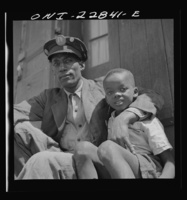 John Vachon worked as a filing clerk for the Farm Security Administration (FSA) before being recruited by Roy Styker to join a small team of photographers employeed to document the conditions of poor, rural areas in the United States. His photographs taken in New Orleans are a mix of street portraiture and shots of working life near the Port of New Orleans.
-
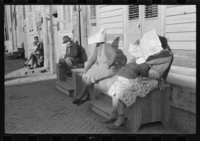 Marion Post Wolcott was a well-educated female photographer who freelanced for Life, Fortune, and other magazines. She was a staff photographer for the Philadelphia Evening Bulletin in 1937, and was later recruited to the Farm Security Administration, where she worked from 1938 to 1942.
-
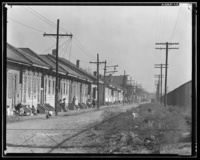 During the Spring and Summer of 1936, FSA photographer Walker Evans traveled to New Orleans. His photographs focus on the streets of the French Quarter, and surrounding poorer areas, as well as the Greek Revival Architecture found in the city.
 Walker Evans
-
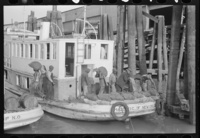 American photographer and photojournalist Russell Lee is best known for his work for the Farm Security Administration (FSA). His images documented the ethnography of various American classes and cultures. In New Orleans, Lee captures the leisure, labor, and exhaustion of New Orleans life during the Great Depression.
 Russell Lee
-
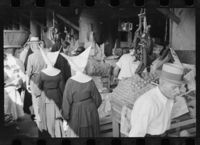 Carl Mydans was a Life Magazine photographer who began his career working for the Resettlement Administration (RA), later named the Farm Security Administration (FSA). He took an extended trip through the South in 1936, documenting the state of Depression-era families and, as part of that trip, came through New Orleans and St. Charles Parish.
 Carl Mydans
-
 Ben Shahn, before his modernist fame, was a photographer for the FSA. Recruited by Walker Evans to join the Resettlement Administration (RA), later named the Farms Security Administration (FSA), Shahn documented the American south with his photography colleagues Walker Evans and Dorothea Lange. During Autumn of 1935, Shahn was active in the French Quarter, capturing city life through his intimate portraiture.
 Ben Shahn
-
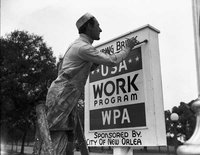 [Untitled]
-
 Midterm Presentation
-
 DADA•Berenson PPT Slide
-
 Monteith
 This vessel, which was intended for chilling wine glasses, does not bear a British coat of arms, but its form derives from an English silver example, suggesting it was intended for an English client.
-
 Dish with a scene of tea cultivation (one of a pair)
 These dishes belonged to a table service decorated with scenes of the cultivation of tea. The upper dish illustrates the production of metal containers for transporting tea. The lower one depicts rattan being applied to the outside of a container, while on the right a man is packing tea by stomping it down. These cylindrical containers were used to transport the tea to Canton, where it was repacked in metal-lined wooden chests for shipment to Europe and elsewhere. Chinese potters' borrowing of French pottery motifs for the border design speaks to the stylistic cross-currents enabled by the extensive trade in the eighteenth century.
-
 [Untitled]
-
 Sauceboat
 Boat-shaped with wavy rim and loop handle with thumb-piece and detatched heart-shaped terminal, the outside moulded with flowers; painted in underglaze blue beneath the pouring with a flower spray. The interior is painted in underglaze blue with flower-sprays and with cell-diaper border.
-
 Taperstick
 As the European market for Chinese porcelain grew, so, too, did the desire for specifically Western forms. In response, Chinese potters looked to European examples in other materials for inspiration. The stepped square-sectioned shape of this porcelain taperstick, for instance, is derived from European metalwork.
-
 Drug Jar
 The Dutch East India Company, the largest trading company between Europe and Asia in the late 17th century, ordered the creation of this vessel, which bears the label “Diacarth”, a reference to a type of medicinal paste. The jar was produced at a Chinese kiln in Jingdezhen, the center of ceramic production in southeastern China.
-
 GRHS logo
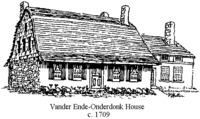
 Logo for the Greater Ridgewood Historical Society and the Vander Ende-Onderdonk House. The logo consists of a black and white sketch outline of the Vander Ende-Onderdonk House with the words "Vander Ende-Onderdonk House c. 1709" written below.
-
 El Hambre En La Ciudad De Mexico, 1914-15
 Woman and children watching two men standing over horse laying on ground.
-
 "A Field Guide to Getting Lost" by Rebecca Solnit
 Written as a series of autobiographical essays, A Field Guide to Getting Lost draws on emblematic moments and relationships in Rebecca Solnit's life to explore issues of uncertainty, trust, loss, memory, desire, and place. Solnit is interested in the stories we use to navigate our way through the world, and the places we traverse, from wilderness to cities, in finding ourselves, or losing ourselves. While deeply personal, her own stories link up to larger stories, from captivity narratives of early Americans to the use of the color blue in Renaissance painting, not to mention encounters with tortoises, monks, punk rockers, mountains, deserts, and the movie Vertigo. The result is a distinctive, stimulating voyage of discovery.
ISBN-10: 9780143037248
ISBN-13: 978-0143037248
-
 "On Being Blue: A Philosophical Inquiry" By William H. Gass
 On Being Blue is a book about everything blue—sex and sleaze and sadness, among other things—and about everything else. It brings us the world in a word as only William H. Gass, among contemporary American writers, can do.
ISBN-10: 1590177185
ISBN-13: 978-1590177181
-
 "Bluets" by Maggie Nelson
 A lyrical, philosophical, and often explicit exploration of personal suffering and the limitations of vision and love, as refracted through the color blue. With Bluets, Maggie Nelson has entered the pantheon of brilliant lyric essayists.
ISBN-10: 1933517409
ISBN-13: 978-1933517407