-
 Portrait of John Westwood
 An oil painting portrait of John Westwood, painted in conventional English portrait style of formal, bust-length pose and arranged backdrop. It depicts a half-length male figure wearing a brown coat with silver buttons and white waistcoat against a dark background. The figure is clean shaven with short brown hair, and is encircled by a faux oval frame. Painted as part of the composition, the oval frame is slightly lighter in color than the background. (Smithsonian Collections Search Center)
-
 Portrait of Adelia Ellender
 Adelia Ellender lived in Baltimore, Maryland, where her father was a plasterer. Her dress follows the custom in this period of portraying children as miniature adults. The berries in her hand and the butterfly hovering in a rosebush nearby symbolize not only her childhood innocence but her eventual transformation into a lady
-
 Series I, No. 10
-
 Joshua Johnson
 Joshua Johnson, or Johnston, the earliest documented professional African-American painter, was active in Baltimore during the late eighteenth and first quarter of the nineteenth century. His background, however, remains a mystery. The families and descendants of those whose portraits he painted claim that Johnson was a former slave. Whether Johnson was a slave or not is open to question since his name appears in the City Directory of Baltimore from 1796 to 1824, when the directory did not list slaves. Johnson's identity as an African American has been questioned as well. In editions of the directory in which an asterisk designated a person of color, there is no asterisk by Johnson's name. Johnson may have been biracial and fair enough to elude identification as an African American by publishers of the directory. In the directory of 1817, however, Johnson's name appears among the "free householders of Color" listed separately in the publication. (Smithsonian American Art Museum)
-
 The Bagpipe Lesson
 This study shows a boy practicing the bagpipe, but for the final version, Henry Ossawa Tanner added a teacher and two more figures. Bagpipe players were common in the French region of Pont-Aven and Concarneau, where Tanner spent his summers in the 1890s. Here, he used bold colors and loose brushwork to capture the scene. Tanner entered a finished version in the annual Paris exhibition, but it was rejected; the Pennsylvania Academy of the Fine Arts, however, accepted it for their yearly show. (Smithsonian Collections Search Center)
-
 Pink and Green
-
 The Banjo Lesson
-
 Blue Line
-
 Title of specific work that is relevant; standardized using Library of Congress Name Authority File.
 Description of relevant work as provided via the web source.
-
 Black Lines
-
 Title of object given from web source of object.
 Description is provided by the web source's description of the object.
-
 Dissertation
-
 Henry Ossawa Tanner
 The most distinguished African-American artist of the nineteenth century, Henry Ossawa Tanner was also the first artist of his race to achieve international acclaim. Tanner was born on June 21, 1859, in Pittsburgh, Pennsylvania, to Benjamin Tucker and Sarah Miller Tanner. Tanner's father was a college-educated teacher and minister who later became a bishop in the African Methodist Episcopalian Church. Sarah Tanner was a former slave whose mother had sent her north to Pittsburgh through the Underground Railroad. Tanner's family moved frequently during his early years when his father was assigned to various churches and schools. In 1864 Tanner's family settled in Philadelphia where his early artistic interests were developed. At age thirteen, Tanner decided to become an artist when he saw a painter at work during a walk in Fairmount Park near his home. Throughout his teens, Tanner painted and drew constantly in his spare time and tried to look at art as much as possible in Philadelphia art galleries. He also studied briefly with two of the city's minor painters. (Smithsonian Museum of American Art)
-
 Romantic Landscape
-
 Scottish Landscape
 Robert S. Duncanson made several trips to Scotland, probably inspired by his father's Scottish heritage. He created romantic wilderness views that may have been influenced by the novels and poems of Sir Walter Scott. In this piece the warm colors and rich vegetation make a remote scene appear welcoming, and would have appealed to the sentimental tastes of his American patrons.
-
 Robert Duncanson
 Robert Scott Duncanson was perhaps the most accomplished African-American painter in the United States from 1850 to 1860. He was born in Seneca County, New York, in 1821 to an African-American mother and Scottish-Canadian father, who sent his son to Canadian schools during his youth. In 1841 Duncanson and his mother moved to Mt. Healthy, Ohio, near Cincinnati. Little else is known about Duncanson's early life except that his second wife Phoebe was biracial, and the couple's only child, a son Mittie, was born in Cincinnati.
-
 The Drinking Pool (three women at the water)
-
 Ocean Cliffs
-
 Approaching Storm
 This windy scene of a lone figure struggling in the face of a storm would have held special meaning for nineteenth-century viewers, who believed that their nation's landscape was infused with God's presence. In 1886, the year he painted Approaching Storm, Edward Mitchell Bannister wrote an essay titled "The Artist and His Critics," in which he argued that spiritual expression is the artist's ultimate goal. (Hartigan, Sharing Traditions, 1985)
-
 Boat on Sea
 The sea was a favorite subject for Edward Mitchell Bannister, who had worked as a cook on a trading ship. In this peaceful view of Rhode Island’s Narragansett Bay, a popular subject for nineteenth-century American artists, he focused attention on the brilliant coastal light. Bannister was a deeply religious man who shared with many Americans of his time a belief that nature was an expression of God’s presence. In this scene the radiant light illuminates the bay to suggest a divine blessing. (Narratives of African American Art and Identity: The David C. Driskell Collection, 1998)
-
 Edward Mitchell Bannister
 Edward Mitchell Bannister became one of the first African American painters to gain national recognition when his landscape Under the Oaks won a first prize at the Centennial Exposition in Philadelphia (1876). Almost entirely self-taught, Bannister began his career in the 1850s in Boston, where he enjoyed the patronage of that city's substantial black community. He was also a committed abolitionist who continued to advocate for African American rights after the Civil War. When Bannister settled in Providence, Rhode Island, in 1869, his reputation grew as his landscapes and coastal views were exhibited more widely. His name proved unfamiliar, however, to the Centennial Exposition judges, who tried to withhold his prize upon discovering that he was African American. When the other artists threatened to withdraw from the competition if Bannister was denied his medal, the original award was upheld.
-
 View of the Lowe Falls, Grand Canyon of the Yellowstone
-
 Portrait of Grafton Tyler Brown
 Portrait of Grafton Tyler Brown, San Francisco artist and lithographer, from "Blacks in the Westward Movement" exhibition at Anacostia Neighborhood Museum.
-
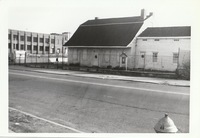 View of Front Facade After Restoration, Vander Ende-Onderdonk House, 1991
 Black and white photograph depicting front view, from across the street, of the Vander Ende-Onderdonk house (Queens, NY) after 1981 restoration. Visible in the image: the stone house, gambrel roof, portion of wood-frame addition, metal fence along front, part of Flushing Avenue, and portion of factory on Onderdonk avenue. This photograph (c. 1991) is part of a physical collection belonging to the Greater Ridgewood Historical Society.
-
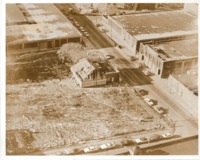 Aerial View from East After Fire, Vander Ende-Onderdonk House, 1978
 Sepia tone photograph depicting aerial view of Vander End-Onderdonk House (Queens, NY) after 1975 fire. Visible in the image: the stone house, gambrel roof, brick addition, yard, Onderdonk Avenue (east), Flushing Avenue (north), and surrounding buildings. There is visible damage to the gambrel roof and top of brick addition. Cars line both avenues. This photograph (c. 1978) is part of a physical collection belonging to the Greater Ridgewood Historical Society.