-
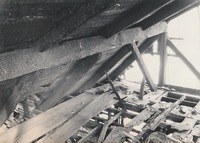 Curb of Gambrel Roof After Fire, Vander Ende-Onderdonk House, 1977
 Black and white photograph depicting partial interior view (attic) of the Vander Ende-Onderdonk House (Queens, NY), after 1975 fire. Visible in the image: partially intact underside of gambrel roof, charred support beams, and remains of wood-plank floor. Attic is covered in debris, floor boards missing and broken, and side wall completely destroyed except for portion of frame. This photograph (c. 1977) is part of a physical collection belonging to the Greater Ridgewood Historical Society.
-
 White Stone
 For more than forty years, Agnes Martin (1912–2004) created serene paintings composed of grids and stripes. With an attention to the subtleties of line, surface, tone, and proportion, she varied these forms to generate a body of work impressive both in its intricacy and focus. Martin’s commitment to this spare style was informed by a belief in the transformative power of art, in its ability to conjure what she termed “abstract emotions”—happiness, love, and experiences of innocence, freedom, beauty, and perfection. This retrospective, her first comprehensive survey in over two decades, presents the scope of Martin’s output, including her biomorphic abstractions of the 1950s, signature grid and stripe compositions, and final paintings. Together these works trace Martin’s practice as she developed and refined a format to express her singular vision.
-
 White Flower
 For more than forty years, Agnes Martin (1912–2004) created serene paintings composed of grids and stripes. With an attention to the subtleties of line, surface, tone, and proportion, she varied these forms to generate a body of work impressive both in its intricacy and focus. Martin’s commitment to this spare style was informed by a belief in the transformative power of art, in its ability to conjure what she termed “abstract emotions”—happiness, love, and experiences of innocence, freedom, beauty, and perfection. This retrospective, her first comprehensive survey in over two decades, presents the scope of Martin’s output, including her biomorphic abstractions of the 1950s, signature grid and stripe compositions, and final paintings. Together these works trace Martin’s practice as she developed and refined a format to express her singular vision.
-
 Untitled
 For more than forty years, Agnes Martin (1912–2004) created serene paintings composed of grids and stripes. With an attention to the subtleties of line, surface, tone, and proportion, she varied these forms to generate a body of work impressive both in its intricacy and focus. Martin’s commitment to this spare style was informed by a belief in the transformative power of art, in its ability to conjure what she termed “abstract emotions”—happiness, love, and experiences of innocence, freedom, beauty, and perfection. This retrospective, her first comprehensive survey in over two decades, presents the scope of Martin’s output, including her biomorphic abstractions of the 1950s, signature grid and stripe compositions, and final paintings. Together these works trace Martin’s practice as she developed and refined a format to express her singular vision.
-
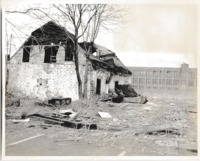 West Exterior and Rear Facade After Fire, Vander-Ende Onderdonk House, 1978
 Black and white photograph depicting side (southwest) view of the Vander Ende Onderdonk House (Queens, NY) after 1975 fire. Visible in the image: the rear facade and west side exterior of the stone house (wood-frame addition was demolished prior to fire), remains of gambrel roof, yard, and debris. Portion of factory, east across Onderdonk Avenue, visible in the background. This photograph (c. 1978) is part of a physical collection belonging to the Greater Ridgewood Historical Society.
-
 Untitled
 For more than forty years, Agnes Martin (1912–2004) created serene paintings composed of grids and stripes. With an attention to the subtleties of line, surface, tone, and proportion, she varied these forms to generate a body of work impressive both in its intricacy and focus. Martin’s commitment to this spare style was informed by a belief in the transformative power of art, in its ability to conjure what she termed “abstract emotions”—happiness, love, and experiences of innocence, freedom, beauty, and perfection. This retrospective, her first comprehensive survey in over two decades, presents the scope of Martin’s output, including her biomorphic abstractions of the 1950s, signature grid and stripe compositions, and final paintings. Together these works trace Martin’s practice as she developed and refined a format to express her singular vision.
-
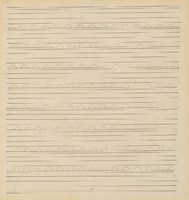 Untitled
 For more than forty years, Agnes Martin (1912–2004) created serene paintings composed of grids and stripes. With an attention to the subtleties of line, surface, tone, and proportion, she varied these forms to generate a body of work impressive both in its intricacy and focus. Martin’s commitment to this spare style was informed by a belief in the transformative power of art, in its ability to conjure what she termed “abstract emotions”—happiness, love, and experiences of innocence, freedom, beauty, and perfection. This retrospective, her first comprehensive survey in over two decades, presents the scope of Martin’s output, including her biomorphic abstractions of the 1950s, signature grid and stripe compositions, and final paintings. Together these works trace Martin’s practice as she developed and refined a format to express her singular vision.
-
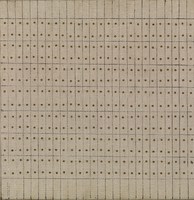 Little Sister
 For more than forty years, Agnes Martin (1912–2004) created serene paintings composed of grids and stripes. With an attention to the subtleties of line, surface, tone, and proportion, she varied these forms to generate a body of work impressive both in its intricacy and focus. Martin’s commitment to this spare style was informed by a belief in the transformative power of art, in its ability to conjure what she termed “abstract emotions”—happiness, love, and experiences of innocence, freedom, beauty, and perfection. This retrospective, her first comprehensive survey in over two decades, presents the scope of Martin’s output, including her biomorphic abstractions of the 1950s, signature grid and stripe compositions, and final paintings. Together these works trace Martin’s practice as she developed and refined a format to express her singular vision.
-
 Dish with John the Baptist
 Christian symbols appear on Chinese porcelain as early as the early sixteenth century, but this unusually large plate is one of the first known works with a biblical scene. The composition depicting John the Baptist and Christ in the Jordan River is based on a passage from the Gospel of Saint Matthew, as indicated by the inscription ("MAT. 3, 16"). The plate may have been intended for export to Europe or for use by recently converted Christians in China.
-
 Dish with IHS monogram, armillary sphere, and Portuguese royal arms
 While the doglike lions illustrate a Chinese theme, the Portuguese coat of arms and the armillary sphere (a type of celestial globe) are often found on works made for Portugal in the early sixteenth century. The letters "I.H.S.," a well-known Latin reference to Jesus Christ, would later be adopted by the Jesuits (Society of Jesus founded in 1534) as a symbol for their order.
-
 Jar with the emblem of the Order of Saint Augustine
 The primary motif on this jar—a double-headed eagle clutching a heart pierced with arrows—served as the emblem of the Catholic Order of Saint Augustine. In the sixteenth century, Augustinian friars established monasteries in Mexico, the Philippines, and Macau (in Southern China); the jar may have been produced for missionaries in one of these locations. While the jar probably served a functional purpose, its white porcelain body and cobalt-blue decoration would have appeared luxurious to friars accustomed to humble vessels.
-
 Saucer
 Porcelain saucer with rounded cavetto and flattened rim. There is a scene of the demolition of Rotterdam during riots in 1690 in underglaze cobalt blue in the centre, and four cartouches containing stylized fruits and flowers against a patterned ground on the cavetto. There are four auspicious motifs on back.
-
 Five-colored Parakeet on a Blossoming Apricot Tree
-
 Judging a Horse
-
 The Thirteen Emperors
-
 Sailboat in Rainstorm
-
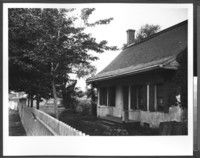 Front View from Northwest (Pre-dormers), Vander Ende-Onderdonk House, 1903
 Black and white photograph depicting partial front view of the Vander Ende-Onderdonk house (Queens, NY). Visible in the image: the stone house, gambrel roof, wood-frame addition, and wooden picket fence along front. This photograph (c. 1903) belongs to the Austin Collection. Digital image available through the Brooklyn Public Library. Original glass plate negatives held at the Brooklyn Museum.
-
 Lotus and Ducks
-
 Finches and Bamboo
 Huizong was the eighth emperor of the Song dynasty and the most artistically accomplished of his imperial line. Finches and Bamboo exemplifies the realistic style of flower-and-bird painting practiced at Huizong’s academy. Whether making a study from nature or illustrating a line of poetry, however, the emperor valued capturing the spirit of a subject over literal representation. Here the minutely observed finches are imbued with the vitality of their living counterparts. Drops of lacquer added to the birds’eyes impart a final lifelike touch.
-
 Night-Shining White
 A leading horse painter of the Tang dynasty, Han Gan was known for capturing not only the likeness of a horse but also its spirit. This painting, the most famous work attributed to the artist, is a portrait of a charger of Emperor Xuanzong (r. 712–56). With its burning eye, flaring nostrils, and dancing hoofs, the fiery-tempered horse epitomizes Chinese myths about Central Asian "celestial steeds" that "sweated blood" and were actually dragons in disguise. The seals and inscriptions added to the painting and its borders by later owners and appreciators are a distinctive feature of Chinese collecting and connoisseurship. The addition of more than one thousand years of seals and comments offers a vivid testimony of the work's transmission and its impact on later generations.
The acquisition of this image, arguably the greatest equine portrait in Chinese painting, marked the Director's early commitment to revitalizing the Department of Asian Art under the curatorial leadership of Wen Fong and with the dedicated support of trustee Douglas Dillon.
-
 Wang Xizhi Watching Geese
 After the fall of Hangzhou, the Southern Song capital, in 1276, the artist Qian Xuan chose to live as an yimin, a “leftover subject” of the dynasty. Painted in his deliberately primitive “blue-and-green” style, this handscroll illustrates the story of Wang Xizhi ( 303 – 361), the calligraphy master of legendary fame and a practitioner of Daoist alchemy, who was said to derive inspiration from natural forms such as the graceful neck movements of geese. In creating a dreamlike evocation of antiquity, the artist prevented a realistic reading of his picture space as a way of asserting the disjuncture he felt after the fall of the Song royal house.
-
 Riverbank
 During the chaotic years following the collapse of the Tang dynasty in 907, centralized rule was shattered and China splintered into a number of short-lived kingdoms. Among the most important of these was the Southern Tang dynasty (937–75), which governed much of the lower Yangzi River delta from its capital at Nanjing. It was there that a distinctive “southern” style of landscape painting developed under the court official and artist Dong Yuan.
-
 Reptiles
 This 2D design was colored and reproduced for Mott the Hoople’s debut recording. The piece also is said to have connotations of the cycle of life.
-
 Out-of-Round X
 Richard Serra, known for his large scale steel sculptures, did this series of works on paper in the late 1990s. The doom metal band Sunn O))) used this piece for their Monoliths & Dimensions recording.
-
 Deep Dish
 The design of this bowl, with a central panel of birds and flowers surrounded by a segmented rim, is typical of the earliest Chinese porcelain made for export to Europe, known as Kraak ware. Produced from the Wanli period (1573–1619) to the end of the Ming dynasty in 1644, these wares were not as refined in shape or decoration as pieces meant for the Chinese court. The origin of the name Kraak was most likely the large Portuguese trading ships used for Asian trade called carracks on which these porcelains were transported to Europe. Kraak porcelain was frequently featured in Dutch still life paintings of foreign luxuries.