-
 The Moulin Rouge (nighttime)
 "The Moulin Rouge, much represented at the time by the artists as a symbol of a Parisian bohemia, emerges from the city landscape. In a nocturnal atmosphere, which the colorist skillfully works, sensations of that zone of the city are represented through the planning of its structure and by marking, here and there, the human movement. Painted in Paris in the early nineties where Sousa Lopes was living as a pensioner, the painting reveals a clear influence of Claude Monet. The blurring of the outlines or the media screen between the viewer and the subject reflect a treatment with Impressionist references. In a dominant tone of dark browns appear small red balls that adorn the mill, manifestation of a proper taste by the chromatic valorization of elements of the composition." -Google Arts and Culture
-
 Feast Scene
 "Born in 1842 in Ferrara, a town in northern Italy, Boldini became firmly established in Paris from 1871 onwards, where he very quickly became a fashionable portraitist and an important witness to the frenetic life of this rapidly expanding, modern city, with its streets, cafés and dances. Here, Boldini is certainly depicting the Moulin-Rouge just after it opened in 1889. The establishment quickly became one of the hot spots of Parisian nightlife.
The vigorous and dynamic brushstrokes and the liveliness of the red recreate the feeling of fun and freedom, sweeping along diners and dancers alike in a brilliantly rendered composition. Before the Musée d'Orsay acquired it in 2010, this painting, certain parts of which remain as in sketch form, had only ever been exhibited once, in 1933 in New York." -Google Arts and Culture
-
 Woman with a Parasol in a Garden
 "In Woman with a Parasol in a Garden, Renoir's language is wholly impressionistic: in a setting lacking a visible horizon, the flowers and shrubs are created with tiny dabs of colour, providing a constant interweaving of textures around the two small figures. The woman, whose parasol shades her from the sun, stands close to the man as he leans down, perhaps to pick a flower, hinting at an intimate relationship.
Contrary to what one may think, this canvas was not painted in the countryside but in the garden of Renoir's new studio in Montmartre. His friend George Rivière recalled: 'As soon as Renoir entered the house, he was charmed by the view of this garden, which looked like a beautiful abandoned park." -Google Arts and Culture
-
 The Swing
 "A young man seen from the back is talking to a young woman standing on a swing, watched by a little girl and another man, leaning against the trunk of a tree. Renoir gives us the impression of surprising a conversation – as if in a snapshot, he catches the glances turned towards the man seen from the back. The young woman is looking away as if she were embarrassed. The foursome in the foreground is balanced by the group of five figures sketchily brushed in the background.
The Swing has many points in common with The Ball at the Moulin de la Galette. The two pictures were painted in parallel in the summer of 1876. The models in The Swing, Edmond, Auguste Renoir's brother, the painter Robert Goeneutte and Jeanne, a young woman from Montmartre, figure among the dancers in The Ball. The same carefree atmosphere infuses both pictures.
As in The Ball, Renoir is particularly trying to catch the effects of sunlight dappled by the foliage. The quivering light is rendered by the patches of pale colour, particularly on the clothing and the ground. This particularly annoyed the critics when the painting was shown at the Impressionist exhibition of 1877. The Swing nonetheless found a buyer – Gustave Caillebotte, who also bought The Ball at the Moulin de la Galette." -Google Arts and Culture
-
 Kerse (Candle)
 Gerhard Richter did a series of still life candles from his own photos in the early 1980’s. The link below describes the importance of Richter's work. Candle was used on Daydream Nation by Sonic Youth.
-
 Lily and Rose
 This image was first published in a photobook entitled Cafe Lehmitz in 1978 by Swedish photographer Anders Petersen. Various versions were subsequently printed and sold at auction. Lily and Rose graced the cover of Rain Dogs by Tom Waits.
-
 Minor Mishap
 An early painting before his word stencils, in Minor Mishap, Wool used commercial rollers to apply paint to the canvas. This lithograph was used on the cover of Sonic Youth’s Rather Ripped.
-
![Weegee (Arthur Felig) [Body of Anthony Izzo, killed by off-duty policeman Eligio Sarro, New York]](https://omekas.prattsi.org/files/medium/0e632ea77c744603bd4dc18d6283a3b018bc61fb.jpg) [Body of Anthony Izzo, killed by off-duty policeman Eligio Sarro, New York]
[Body of Anthony Izzo, killed by off-duty policeman Eligio Sarro, New York] Weegee was known to be on the murder scene before the murderer. John Zorn paid homage to Weegee using this grizzly shot for his Naked City.
-
 Tattoo Parlor
 For his influential book, The Americans, Frank took thousands of photographs across the United States. This one of a collage at a tattoo parlor in New York City did not make the book, but did become the famous cover for the Rolling Stones’ Exile on Main Street.
-
 A Basket of Roses
 A classic still life that was popular with collectors in the 1890’s. New Order used this exact reproduction for their second album.
-
 What May Come (Mexico, 1945)
 A signal image in Méndez’s oeuvre, this work is one of only three self-portrait prints made by the artist. Also known as Danger over Mexico and That Which Must Not Come, the print reflects upon the role of the politically engaged artist in Mexico at the end of World War II, a period of great uncertainty. In the print, the figure of Méndez lies across an open sketchbook and contemplates a nightmarish vision in which Mexican national symbols—the eagle, snake, and nopal cactus (references to the legend of the founding of Tenochtitlan, ancient Mexico City)—are grotesquely inverted, and social order is threatened by reactionary forces. The eagle, symbol of the Mexican republic, hangs on a swastika-cross, and behind, a column of fascist soldiers, supported by Catholic clerics, marches on Mexico City.
The museum’s Print and Drawing Club commissioned Méndez to make the woodblock for this print.
-
 Greenwood, Mississippi
 Also known as “The Red Ceiling” Eggleston comments on his work: “ 'The Red Ceiling' is so powerful that, in fact, I've never seen it reproduced on the page to my satisfaction. When you look at a dye-transfer print it's like it's red blood that is wet on the wall.”
This beautiful piece became synonymous with Big Star, Radio City.
-
 White Light
 Ornette Coleman connected to Jackson Pollock because of the free form yet controlled style of his painting. This piece is reproduced in a gatefold cover for Free Jazz.
-
 Sir John Herschel
 This image depicts "Sir John Herschel, Victorian England’s preeminent scientist, astronomer, and mathematician, considered the equal of Sir Isaac Newton. Herschel wrote to her in Calcutta of Henry Talbot’s invention of photography and sent her the first photographs she had ever seen. Of her 1867 portraits of Herschel, she wrote: “From my earliest girlhood I had loved and honoured him, and it was after a friendship of 31 years’ duration that the high task of giving his portrait to the nation was allotted to me.”
Of the four exposures Cameron made in April 1867, Herschel preferred this one, which portrayed him, he thought, as an 'old Paterfamilias.'"
-
 Alfred, Lord Tennyson
 This image depicts the renowned English poet, Alfred Lord Tennyson. In addition to Cameron's multiple portraits of Tennyson, the poet commissioned a series of images to accompany his collection of twelve narrative poems called Idylls of the King.
-
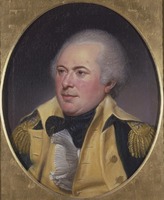 James Wilkinson
 Painting of James Wilkinson
-
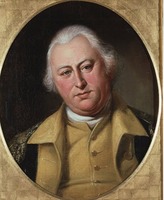 Benjamin Lincoln
 Painting of Benjamin Lincoln
-
 Henry Taylor
 This image depicts the poet and dramatist, Henry Taylor. Taylor was a frequent sitter for Cameron over the course of her career. In addition to multiple portraits, Taylor is featured in her Idylls of the King work for poet, Lord Tennyson.
-
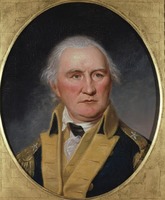 Daniel Morgan
 Painting of Daniel Morgan
-
 George Frederick Watts
 This portrait depicts the English sculptor and painter, George Frederick Watts. Cameron and Watts met in the Little Holland House, an artist salon run by the sister of Cameron's husband.
-
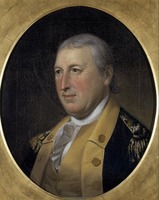 Horatio Gates
 Painting of Horatio Gates
-
 Gareth and Lynette
 “At the Poet Laureate Alfred, Lord Tennyson's suggestion, Julia Margaret Cameron created a series of illustrations for his epic poem Idylls of the King. "
This image was created to accompany the second section of the Idylls entitled "Gareth and Lynette." It depicts Lynette looking upon Gareth as he sleeps.
-
 Battle of Saratoga (September 19, 1777)
 Print of the Battle of Saratoga.
-
 Bronze Medal of Horatio Gates, the Victory at Saratoga, Oct. 17, 1777
 Bronze coin of Horatio Gates at the surrender at the Battle of Saratoga
-
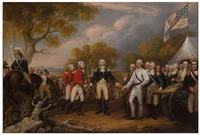 The Surrender of General Burgoyne at Saratoga, October 16, 1777
 A painting by John Trumbull depicting the Surrender of General Burgoyne at the Battle of Saratoga