-
 Trophy Cannon (British Light Three-Pounder Cannon)
 Cast Bronze, Wood and Iron Cannon, Revolutionary War,
-
 Queen Guinevere
 “At the Poet Laureate Alfred, Lord Tennyson's suggestion, Julia Margaret Cameron created a series of illustrations for his epic poem Idylls of the King. "
This image was created to accompany the 10th section of the Idylls entitled "Guinevere." It depicts the figure of Queen Guinevere, wife of King Arthur who falls in love with Sir Lancelot.
-
 The Mountain Nymph Sweet Liberty
 This image depicts a female model as a mountain nymph named Sweet Liberty. The image takes its name from the poet John Milton's work entitled L'Allegro, a celebration of the pleasures of life.
-
 The Passing of King Arthur
 “At the Poet Laureate Alfred, Lord Tennyson's suggestion, Julia Margaret Cameron created a series of illustrations for his epic poem Idylls of the King. "
This image was created to accompany the final section of the Idylls entitled "the Passing of King Arthur." It depicts the mythic leader in medieval chainmail armor and a helmet, holding tightly to a sword.
-
 The Parting of Sir Lancelot and Queen Guinevere
 “At the Poet Laureate Alfred, Lord Tennyson's suggestion, Julia Margaret Cameron created a series of illustrations for his epic poem Idylls of the King.
The images that Cameron created for the Idyllsare the most illustrative works she made; she took great care with the details of costumes and props to insure the photographs' faithfulness to his narrative. She employed a variety of people as models, going to great lengths to ensure the appropriateness of sitter to subject. This image depicts the final embrace of the tragic lovers before they are forever parted.”
-
 Ellen Terry at Age Sixteen
 "This contemplative portrait of Ellen Terry shows as a new bride during the Shakespearean actress's honeymoon stay at Freshwater on the Isle of Wight, where Cameron lived. Terry had married the portrait painter George Frederick Watts.
Terry's forlorn expression and nervous gesture may be an actress's performance put on for the camera.
Employing a non-fading print process used for commercially distributed pictures, Cameron's printer made multiple carbon prints available for purchase by Terry's and Cameron's fans."
-
 Robert Browning
 This is a portrait of the English poet and playwright, Robert Browning. It was taken at the Little Holland House, according to inscription on the mount, an artists' salon run by the sister of her husband.
-
 Divan Japonais
 "With over 200 prints from the so-called Belle Epoque, the Bremen Kunstverein’s collection of French posters is reckoned to be among the largest of its kind in Germany. This well-known poster by Henri de Toulouse-Lautrec was an advertisement for the Divan Japonais, a small café-concert hall in Montmartre decorated in the Japanese style. In the foreground is a silhouette of Jane Avril, a friend of the artist, famous for her wild and obscene dance performances. Her companion is Edouard Dujardin, the writer and founder of the Revue Wagneriénne. Above the outlines of the violin necks and the baton of the conductor in the orchestra pit, Toulouse-Lautrec allows us a glimpse of the stage, where the chanson singer Yvette Guilbert is performing. Since by this time Guilbert had long been working in larger establishments, Toulouse-Lautrec had to portray her without her head for reasons of advertising regulations. Nevertheless, she may be clearly identified by her signature long black gloves." -Google Arts and Culture
-
 Boulevard de Clichy
 "The Boulevard de Clichy is a street in Montmartre, the artists’ neighborhood where Vincent stayed with his brother Theo in Paris, France from March 1886. They lived nearby, first on the Rue de Laval for several months and, from June on, in a larger apartment on the Rue Lepic.
The Boulevard played an important role in Van Gogh’s life. The Café du Tambourin and the Moulin Rouge were located here, as was the studio of Fernand Cormon, where he studied for a time. Several of his friends lived here as well: John Russell, Georges Seurat and Paul Signac – the “Impressionistes du Petit Boulevard,” as Vincent referred to them." -Google Arts and Culture
-
 An Englishman at the Moulin Rouge
 "Henri-Marie-Raymond de Toulouse-Lautrec-Monfa was the son of an aristocratic family of Toulouse. His parents could trace their ancestors all the way to Charlemagne. Since his father and mother were first cousins, their offspring inherited a serious bone disease and stopped growing early. Constantly required to rest, the little boy started drawing and painting.
In one of the three windmills left as a memento on the Butte Montmartre, the Paris Moulin Rouge opened in 1889, in the place of a failed drinking establishment. Commercial show-business was already in full swing in Montmartre. Aware of this, the investors in the new venture faced up to the competition with a flood of newspaper articles and posters to reach the middle-class public: they promised sensational shows, masked balls, electric and gas lighting, and had recourse to every standard “everybody who is anybody comes here” trick. Paris by night was also an inexhaustible source of subjects for Toulouse-Lautrec. From the 1890s onwards, he was attracted exclusively by the cabaret and its stars, the circus, and the world of night entertainment. The fin-de-sičcle Paris market and critical acclaim also encouraged him in his choice of themes.
The coloured lithograph, An Englishman at the Moulin Rouge displays Lautrec’s exceptional talent for caricature. In an interior of exaggerated lines and plane-like patches of colour, two prostitutes are speaking with a man in a top hat, in a frame close to the viewer. The facial expressions and self-confident postures of the women proclaim their experience on the “hunting grounds”. The artist records this crucial moment of night life with elegant economy: the largest patch of colour is the brown tone of the male figure, which is echoed in the colour of the hat of the woman opposite, just like the yellow of the background bar in the colour of the chair in the foreground. Despite the figures’ close proximity and their static posture, it is as if we are viewing a snapshot of a scene in motion. This illusion is reinforced by Lautrec’s favourite device, cutting off the edges of the picture: the scene seems to continue beyond the field of view." -Text: © ZSUZSANNA GILA, Google Arts and Culture
-
 Prometheus
 Prometheus: Titan of Deception, and Bringer of Fire.
-
 Prometheus Bound + Prometheus Unbound
 “This book contains two major works. The first is the Aeschylus play, Prometheus Bound, masterfully translated by Percy Bysshe Shelley and his cousin, Thomas Medwin. The second is Shelley's own poem, Prometheus Unbound, which is considered his masterpiece.”
-
 Frankenstein
 “At once a Gothic thriller, a passionate romance, and a cautionary tale about the dangers of science, Frankenstein tells the story of committed science student Victor Frankenstein. Obsessed with discovering the cause of generation and life and bestowing animation upon lifeless matter, Frankenstein assembles a human being from stolen body parts but; upon bringing it to life, he recoils in horror at the creature's hideousness. Tormented by isolation and loneliness, the once-innocent creature turns to evil and unleashes a campaign of murderous revenge against his creator, Frankenstein.”
-
 Protagoras
 “Widely regarded as his finest dramatic work, the Protagoras, set during the golden age of Pericles, pits a youthful Socrates against the revered sophist Protagoras, whose brilliance and humanity make him one the most interesting and likeable of Socrates' philosophical opponents, and turns their encounter into a genuine and lively battle of minds.”
-
 Metamorphoses
 “Ovid’s sensuous and witty poem brings together a dazzling array of mythological tales, ingeniously linked by the idea of transformation—often as a result of love or lust—where men and women find themselves magically changed into new and sometimes extraordinary beings. Beginning with the creation of the world and ending with the deification of Augustus, Ovid interweaves many of the best-known myths and legends of ancient Greece and Rome, including Daedalus and Icarus, Pyramus and Thisbe, Pygmalion, Perseus and Andromeda, and the fall of Troy. Erudite but light-hearted, dramatic and yet playful, Metamorphoses has influenced writers and artists throughout the centuries from Shakespeare and Titian to Picasso and Ted Hughes.”
-
To One Who Said "You're a Prometheus in Words"
N/A
-
Prometheus
N/A
-
Dialogues of the Gods
N/A
-
 Works and days
 “…the Works and Days offers a compendium of moral and practical advice for a life of honest husbandry.”
-
 Theogony
 “The Theogony contains a systematic genealogy and account of the struggles of the gods …”
-
 Birds
Birds " In The Birds, two cunning Athenians persuade the birds to build the utopian city of 'Much Cuckoo in the Clouds' in the sky, blockading the Olympian gods and installing themselves as new deities.”
-
 Prometheus Bound
 “Aeschylus (525–456 BC) brought a new grandeur and epic sweep to the drama of classical Athens, raising it to the status of high art. In Prometheus Bound the defiant Titan Prometheus is brutally punished by Zeus for daring to improve the state of wretchedness and servitude in which mankind is kept."
-
 Joséphine Gaujelin
-
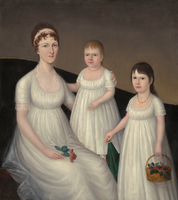 Grace Allison McCurdy (Mrs. Hugh McCurdy) and Her Daughters, Mary Jane and Letitia Grace
-
 Eye - The Cleveland Museum of Art
 Watercolor on ivory set in a ring with split pearl border
Unframed: 1 cm (3/8 in.); Diameter of frame: 1.5 cm (9/16 in.)