-
 Eye - The Cleveland Museum of Art
 Watercolor on ivory
Diameter of frame: 2.4 cm (15/16 in.)
-
 Portrait of a Left Eye - Philadelphia Museum of Art
 Watercolor on ivory.
Dimensions: 5/16 x 1/2 inches (0.8 x 1.3 cm)
-
 Virgin and Child with an Angel
-
 Portrait of a Right Eye - Philadelphia Museum of Art
 Watercolor on ivory, mounted on a ring.
Dimensions: 1 1/8 x 11/16 inches (2.9 x 1.7 cm)
-
 Prometheus and Digital Sculpture
 “The piece is my [Eaton’s] own interpretation of the Prometheus myth, and is not based on any existing sculptures.”
-
 Eye Miniature - Victoria and Albert Museum
 Square frame edged with 12 pink stones. Brown iris. Close up of face.
-
 Eye Miniature - Victoria and Albert Museum
 Portrait miniature of an eye, probably male, medium brown in color, with fringe of red hair also visible.
-
 Eye Miniature - Victoria and Albert Museum
 Oblong frame set with 14 dark pink stones. Blue iris. Close up of face.
-
 Prometheus (for Franz Kafka)
 “Tucker was a leading member of the New Generation of sculptors in London in the mid sixties. Their influence on Australian steel sculpture has continued to the present. Tucker however has moved on to other media and very different forms. This vast sculpture was made in plaster and cast directly in bronze. It suggests animated form being drawn up out of the earth. The cloud like volume may be seen as humanoid or as primal matter. Unlike other contemporary artists making large scale bronzes the original was modelled full size by the artist and not enlarged by technological processes. The surface is therefore a direct impression of the making process and the artist's gestures.”
-
 Portrait of a Right Eye - Philadelphia Museum of Art
 Watercolor on ivory
Dimensions:Diameter: 3/4 inches (1.9 cm)
-
 Portrait of a Left Eye - Philadelphia Museum of Art
 Watercolor on ivory
Dimensions: 1/4 x 1/2 inches (0.6 x 1.3 cm)
-
 Memorandum Case with a Portrait of a Woman's Left Eye - Philadelphia Museum of Art
 Memorandum case with an insert of seven ivory leaves and two pencils.
Miniature: 1 5/16 x 9/16 inches (3.3 x 1.4 cm) Case: 3 7/8 x 3 3/16 inches (9.9 x 8.1 cm)
-
 Prometheus
 “Prometheus is said to be the best-known sculpture in Rockefeller Center and the most photographed monumental sculpture in all of NYC. Created by famed American sculptor Paul Manship, who held a great fascination for mythological subjects and events, it has become the main attraction of the Lower Plaza. Its central theme is best stated by the quote that’s carved in the red granite wall behind him, taken from the sixth-century B.C. Greek dramatist Aeschylus: ‘Prometheus, Teacher in Every Art, Brought the Fire That Hath Proved to Mortals a Means to Mighty Ends.’”
-
 Eye Miniature - Victoria and Albert Museum
 Oval shaped frame set with 20 small pearls. Blue iris. Close up of face. Two diamond "tears".
-
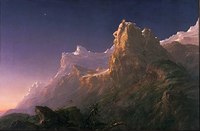 Prometheus Bound
 “In classical mythology, Prometheus was an immortal giant who aided the human race by stealing fire from the gods. As punishment he was chained to Mount Caucasus in Scythia and condemned to have his liver plucked out by a vulture each day, only to have it renewed and then devoured again the next. Thomas Cole is best known as a landscape painter, and here the figure of Prometheus—the ostensible main subject of the painting—is secondary to the vast mountain range that surrounds him. Research suggests that Cole, an abolitionist, may have chosen this subject to create a moral allegory of the evils of slavery, symbolized most potently by the shackles that bind Prometheus to the rock.”
-
 Prometheus, naked, chained to a rock, looking up at an eagle standing over him
 N/A
-
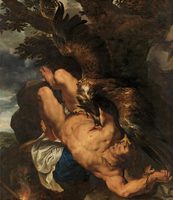 Prometheus Bound
 “In Greek mythology the Titan Prometheus stole fire from the gods on Mount Olympus to give to humanity. Furious, Zeus, king of the Olympians, ordered Prometheus forever chained to a rock, where each day an eagle would devour the Titan’s perpetually regenerating liver. This painting, which Rubens considered one of his most important works, represents the virtuoso artist at his absolute height. Working in collaboration, a common practice for master artists in Antwerp in the first two decades of the seventeenth century, Rubens and the famed animal and still-life painter Frans Snyders, who contributed the eagle, rendered the brutal tale of Prometheus with corresponding violence. The enormous bird’s beak rips open the Titan’s torso, exposing blood-soaked entrails. To gain purchase on the captive’s flesh, one of the eagle’s talons gouges Prometheus’s right eye. His left eye is locked on the predator, signaling he is fully aware of his torture, while his writhing legs, clenched fist, and tousled hair convey the Titan’s abject agony. Rubens, who intensively had studied the art he saw on his travels to Italy, Spain, and England, derived the hulking figure of Prometheus, with its broad frame and dense musculature, from prototypes by Michelangelo. The picture’s asymmetrical composition, in which Prometheus tumbles downward with his left arm almost reaching beyond the canvas, was inspired by a painting by Titian of the giant Tityus (1548–49; Museo del Prado, Madrid). Here Rubens masterfully synthesized and melded these sources with his own Baroque sensibilities. Christopher Atkins, from Philadelphia Museum of Art: Handbook. Philadelphia: Philadelphia Museum of Art, 2014, pp. 126–127.”
-
 Lover's Eyes - The Metropolitan Museum of Art
 Watercolor on ivory painting
Lock of human hair
1 X 3/4 in. (2.5 X 1.9 cm)
-
 Prometheus, Chained to Mount Caucus, has his Liver Devoured by an Eagle
 “The Titan Prometheus, protector of men, stole fire from Mount Olympus. Furious, Zeus inflicted a terrible and cruel punishment on him. He chained him to the summit of Mount Caucasus, where an eagle came daily to peck at his liver, which constantly replenished itself. Prometheus, straining his every muscle, screams in agony. The instrument of his crime, the torch, lies at his feet.”
-
 Montmartre: behind the Moulin de la Galette
 "Van Gogh painted this large landscape near his home on the hill of Montmartre. The north side of the hill was dotted with vegetable gardens. Van Gogh painted with quick, loose brushstrokes, revealing the influence of (Neo)-Impressionism. The painting was shown in 1888, alongside the work of other cutting-edge artists at the Salon des Indépendants exhibition.
Van Gogh was highly satisfied with this landscape. He had considered donating it to the Museum of Modern Art in The Hague, which had opened in 1884, in order to show his new work to his fellow countrymen. (See letter to Theo van Gogh, 3 April 1888). It was a plan he would never actually carry out." -Google Arts and Culture
-
 Postcard: Surrender of Burgoyne, Saratoga, Oct. 17, 1777
 Souvenir postcard depicting General Burgoyne surrender during the Battle of Saratoga in the American Revolution
-
 Boulevard Montmartre, Spring
 "One of a series of fourteen works painted between February and April, Boulevard Montmartre: Spring epitomizes Pissarro’s ability to seize unique moments, such as a specific hour or season. From his hotel room overlooking the boulevard, he captured the life and movement of the street in small, rapid brushstrokes. Pissarro considered his work very modern in conception: “I am delighted to be able to paint these Paris streets that people have come to call ugly, but which are so silvery, so luminous and vital.”
Until 1935, Boulevard Montmartre: Spring was in the collection of Max Silberberg, a Jewish industrialist and art collector from Breslau, Germany. It was then sold in a forced sale by Paul Graupe’s auction house in Berlin. Max Silberberg and most of his family perished in the Holocaust.
In 1999, representatives of the Silberberg Estate asked the Museum and its American Friends to make restitution of the painting. Ownership was restored to Max Silberberg’s daughter-in-law and heir. Boulevard Montmartre: Spring remains in Jerusalem on extended loan through her generosity.
Formerly a bequest of John and Frances L. Loeb, New York, to American Friends of the Israel Museum, Now extended loan from the daughter-in-law of Max Silberberg, Breslau." -Google Arts and Culture
-
 Dance at Le Moulin de la Galette
 "This painting is doubtless Renoir's most important work of the mid 1870's and was shown at the Impressionist exhibition in 1877. Though some of his friends appear in the picture, Renoir's main aim was to convey the vivacious and joyful atmosphere of this popular dance garden on the Butte Montmartre. The study of the moving crowd, bathed in natural and artificial light, is handled using vibrant, brightly coloured brushstrokes. The somewhat blurred impression of the scene prompted negative reactions from contemporary critics.
This portrayal of popular Parisian life, with its innovative style and imposing format, a sign of Renoir's artistic ambition, is one of the masterpieces of early Impressionism." -Google Arts and Culture
-
 Untitled statuette
 “Statuette; ivory; carved; a nude figure in the form of Prometheus, who is shackled and chained at his wrists and ankle to a rock; the chains and rock are made of bronze, attached to a rectangular base by means of a screw with a washer in the form of a coin.”
-
 The creation of man by Prometeus
 “Prometeus, seated, is intent on observing his creature; the man, still a motionless clay puppet, stiffly lying at his feet, is surrounded by the greatest deities of the Greek pantheon. In a pre-eminent position there are Hera and Zeus in the act of giving Hermes the money with which to redeem the life of man from the Hades. Next to Hermes there is Poseidon with his trident; in the two upper corners, the chariot of Selene and the chariot of Apollo between Zeus and the man; finally, the Erotes induce Psyche, the soul, to give birth to the first human being.”