-
 Pair of gloves
 A pair of red silk ecclesiastical gloves from Spain, marking some of the earliest examples of knitting on the European continent. These gloves also show how intricate color work had become. Knit in the round, the maker used yellow silk wrapped in silver strip to create many religious symbols on the glove like a cross surmounting a heart, a shepherds crook and reliquary. The cuffs have a geometric pattern and Greek wave which is repeated on the fingers. Yellow bobbin lace gives the appearance of seam lines.
-
 Flat cap
 Similar to other caps from this time, this cap of green wool highlights the protective nature of these caps with ear flaps and a longer neck. Construction suggests that this cap was worked flat joining in the round for the top and the ear flaps were constructed separately and seamed at the end. During this time, knitted caps were usually felted heavily in order to imitate velvet.
-
 Cap
Cap This reddish-brown closely knitted cap with flat crown, has lost original felt surface and presumably bright red color. The cap has a slightly projecting brim of reverse stocking stitch construction. there are the remains of strings attached at each side suggesting that the cap was meant to be tied at the crown. Size suggests it may have belonged to young boy/small adult male however its was popular during the time for men to wear these caps on the side of the head, rather than on top. The manufacture of caps during this time was mandated from 1488 on control by Act of Parliament. In 1571, the “Cappers Act” stated that every person above the age of six years (excluding women and noblemen) shall wear a “on Sundays and Holidays a cap of wool, thickens and dressed in England” in order to keep the domestic production alive. This attributes the owner as securely in the middle class.
-
 Sock
Sock Earliest example of double-needle knitting. Made in North Africa during Islamic rule as assumed from the indigo and white designs that echo color combinations found in most islamic ceramics of the time. The sock was most likely worked from toe to top with difference in needle size accounting for the change in gauge.
-
 Pair of socks
 The Romano-Egyptian socks were excavated from ancient Oxyrhynchus, a Greek colony on the Nile in central Egypt at the end of the 19th century. They use a technique called nålbinding which predates modern knitting. The socks were made with red wool and each sock has a divided big toe so as to be worn with sandals. The construction of these socks, which have a turned heel, began at the toe and finished at the ankle with added stitches in the front to form an under-flap, ending in a loop, for fastening or tying.
-
 New Babylon-Antwerpen
-
 A Dip in the Lake: Ten Quicksteps, Sixty-two Waltzes, and Fifty-six Marches for Chicago and Vicinity
 A leading figure of the American post-war avant-garde, John Cage is famous for his silent composition of 4'33". This work connects random addresses together in Chicago, and was intended for these random locations to be sites of sound recordings.
-
 Nam June Paik sitting on TV Chair
-
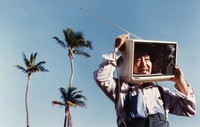 Nam June Paik in Miami
-
 Luchasaurus
 Luchasaurus is the in-ring persona of professional wrestler Austin Matelson (Born 1985)
-
 Dino the Dinosaur
 Dino is the prehistoric pet of fictional cartoon family, The Flintstones
-
 Dinosaur bones, National Museum of Natural History, Washington, D.C.
 The arranged bones of an Albertosaurus
-
 DINOSAUR. MOUNTED SPECIMEN IN SMITHSONIAN
 Dinosaur specimen of the Smithsonian, mounted with lifelike skin texture
-
 Norman Ross of the division of Paleontology, National Museum, preparing the skeleton of a baby dinosaur some seven or eight million years old for exhibition
 Photograph of a baby dinosaur specimen being prepared for exhibition
-
 Gertie the dinosaur standing on a cliff edge looking at a mastodon
 Copy of cel from "Gertie the dinosaur", one of the earliest known animated films.
-
 Wall Drug dinosaur, Wall, South Dakota
 A roadside dinosaur attraction advertising Wall Drugstores in South Dakota
-
 Tyrannosaurus Rex dinosaur skeleton at the Denver Museum of Nature & Science in Denver, Colorado
 Photograph of Tyrannosaurus Rex skeleton from the Gates Frontiers Fund Colorado Collection at the Denver Museum of Nature & Science
-
 Robosaurus
 Robosaurus breathes fire while eating a car
-
 Roar
Roar
-
 DINOSAUR SKELETON.
 Unidentified specimen documented in the early 20th century
-
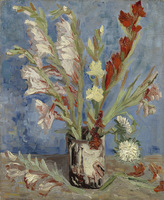 Vase with Gladioli and Chinese Asters_Vincent Van Gogh
 This is one of more than 35 flower still lifes that Van Gogh painted in Paris in the summer of 1886. He hoped that paintings of flowers would sell well. These were also exercises in the use of colour and a loose style of painting. In this still life, he worked with strong colour contrasts in complementary colours, placing green and red side by side, or blue and orange. Pairs like these form the basis of the colour theory of Eugène Delacroix (1798-1863), an artist Van Gogh greatly admired.
-
 A woman in a bird mask, N.Y.C., 1967
-
 Two ladies walking in Central Park, N.Y.C., 1963
-
 Woman with eyeliner, NYC, 1967/2003
-
 Seated man in a bra and stockings, N.Y.C., 1967