-
 Kusama's Self-Obliteration
 1968 film by Japanese artist Yayoi Kusama and the late experimental filmmaker Jud Yalkut. Kusama produces and stars in the film, which has a psychedelic feel and non-narrative structure.
It starts with Kusama in rural upstate New York, covering animals, plants and a naked male body with polka dots. She uses this action throughout her career as a metaphor for giving up identity, abolishing uniqueness and becoming one with the universe - or 'self-obliteration'.
The film goes on to show body-painting in the artist's installation environments or 'happenings'. These 'happenings' embraced the new hippie culture that had been on the rise in the US since the mid-60s, as well as sexual liberation, opposition to the Vietnam War and a yearning for change following civil rights injustices.
They also saw a shift in art with a move away from the restraints of the gallery space and its conventions of traditional painting and sculpture. Kusama's 'happenings' took place in New York parks and public spaces such as Central Park and Brooklyn Bridge, as well as in galleries, and would often involve audio-visual-light performances where she painted naked models with paints or covered them in polka dots.
The film was so popular in art-house film circles that Kusama set up a company to sell prints from the film. It also went on to win prizes in the Fourth International Experimental Film Competition in Belgium as well as the Maryland and Ann Arbor Film Festivals in the US.
-
 Some Stories
 Presented without commentary, this film reveals the thinking behind his work and provides clues to the understanding of the artist's paintings, photographic work and books. What emerges is a portrait of a thoughtful, quietly rebellious artist who has influenced a large number of younger artists over the last 20 years. 1990, 28 mins.
This tape reveals Baldessari's thoughts and intentions for his work over the course of his career, providing clues to the understanding of his paintings, books, and photos. What emerges is a portrait of a rebellious artist who attempts to undermine the catagories and dogmas of the art world- with the full realization that in the long run, some catagory or other will be named to label his work.
-
 On the ethical character of art
 Motherwell discusses the ethical character of art in this segment of the 1964 public television program ART: New York.
-
 Döden, rökande, med lie över axeln
 This late work features Arosenius's most potent figure of Death, as a towering figure standing over a landscape with tiny, fleeing people. A cigar and pince-nez lend Death an aristocratic air, as if he has grown wealthy from years of bountiful harvests.
-
 Krig
Krig In this early drawing, Arosenius fancifully depicts a skeletal Death lounging on a hillside, smoking a cigarette as an army conducts its deadly work in the background. The drawing presages later work by the likes of Otto Dix, who would depict the carnage and misery of World War One in a more fully realized (but not dissimilar) manner.
-
 Självporträtt med pil i blödande hjärta
 This drawing is one of many in which Arosenius identifies his hemophilia with his unrequited love for the actress Ester Sahlin, a member of his circle. Being a deeply personal work from the archives, it makes no concessions to subtlety or restraint.
-
 Livet och döden
 Here Arosenius expresses the brevity of life in the short distance between voluptuous life and skeletal death.
-
 Uggla med dödskallehuvud
 An owl with the hollow eyes of a skull gazes over a twilit rural landscape. In this late work, Arosenius envisions death as a silent, watchful, and patient predator.
-
 Trollkarlen och kvinnofågeln
 This most desolate item from a narrative group of paintings depicts Arosenius in Orientalist garb as a young wizard, his bleeding heart being plucked out by a carrion bird.
-
 Det brustna hjärtat
 A callipygian fairy, standing in for actress and Arosenius crush Ester Sahlin, makes off with the artist's heart. He sits dismayed and spurting blood, as blood-spraying demons swoop in from behind.
-
 Självporträtt på moln
 This most stylized and abstracted of Arosenius's works is something of a mystery. The inscription reads, ""Fan, vad jag är begåfvad!", roughly translated: "damn, how gifted I am!" What are we to make of this commentary? The distorted Arosenius sits on a cloud. Is he dead, or merely disconnected from the cityscape below? Is it a position of elevation, alienation, or confusion? Is he dead?
-
 Solnedgång
 Arosenius, in his typical long coat and shabby hat, summons a host of devils and serpents with his flute. A red rising sun and pair of six-pointed stars drip blood as a cityscape on the horizon burns.
-
 Döden
Döden
-
 Flowers
-
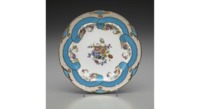 Plate (Part of a Dessert Service)
-
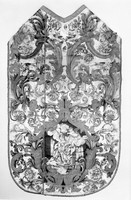 Chasuble
 The medallion on the front shows Saint Joseph with the Christ Child. The Annunciation is depicted on the back.
-
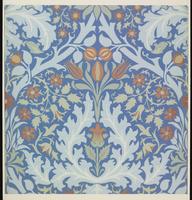 Autumn Flowers
 Portion of 'Autumn Flowers' wallpaper, a pattern of foliage, flowers and fruit, with a central vertical axis of symmetry, the majority of design in pale-blue, (?)green and red, on a blue ground; Print on paper.
-
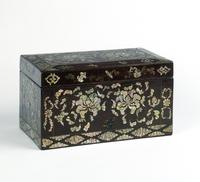 Box inlaid with potted peony flowers
 The sides and lid of the box are decorated with a lotus design created using mother of pearl inlay. On the front panel and the lid the flowers are joined to a small tortoiseshell flowerpot by a stem made of twisted copper wire.
Auspicious symbols adorn the side of the lid.
Colour: Brown
-
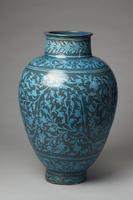 Vase
Vase Thin turquoise glaze over white underpainted flowers on scrolling lines.
-
 Tiara
Tiara Tiara in the form of a wreath, brilliant-cut diamonds with a few rose-cut specimens in three attached units, set in silver and backed with gold. The basic structure is a wreath of Neoclassical design. The honeysuckle palmette on a trembler a later addition of 1860–80, replacing a damaged flower
-
 Rosa Sulfurea; Rosier a fleurs jaune soufre (syn)
 Stipple engravings
-
 Rosa Indica Fragrans; Rosier des Indes odorant
 Stipple engravings
-
 Rosa Centifolia; Rosier de Provence (syn.)
 Designed by Matteo Florimi, Italian, active Siena, ca. 1581-died 1613, published by Francesco de' Franceschi, Italian, active 16th century, Venice.
From top to bottom, and left to right:
Design decorated with squares ornamented with an alternating pattern of circles with flowers at the center and diamonds containing different floral motifs.
-
 Henry Morgan
 Color illustration of Henry Morgan from Alexandre Exquemelin's "The Buccaneers of America"
-
 William Kidd
 Illustration of William Kidd, after his execution from Charles Ellms & Samuel Nelson Dickinson's "The Pirates Own Book"