-
 Bartholomew Roberts
 Copper engraving of Bartholomew Roberts in "General History of the Robberies and Murders of the Most Notorious Pyrates" , plate opposite pg. 202
-
 Mary Read
 Illustration of Mary Read in battle, from Charles Ellms & Samuel Nelson Dickinson's "The Pirates Own Book" p. 382
-
 Stede Bonnet
 Woodcut of Stede Bonnet from "The History and lives of all the most notorious pirates, and their crews"
-
 Jack Rackham
 Illustration in Daniel DeFoe's "The History and lives of all the most notorious pirates, and their crews"
-
 Charles Vane
 Illustration from Daniel Defoe's "The History and lives of all the most notorious pirates, and their crews."
-
 Grace O'Malley
 The meeting of Grace O’Malley and Queen Elizabeth I at Greenwich Castle, September 1593. Illustration from Anthologia Hibernica, vol. 11, 1793.
-
 Anne Bonny
 From the 1725 edition of Charles Johnson's A General History of the Robberies and Murders of the Most Notorious Pyrates [sic]
-
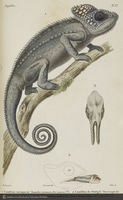 [Untitled]
-
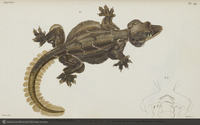 [Untitled]
-
 Edward Teach (Blackbeard)
 Illustration from General History of Pirates vol. 1, opposite page 70.
-
 Narcomedusae, spangenquallen
 Lithograph, Tafel 16, Pegantha from Haeckel's Kunstformen der Natur.
-
 Ctenophorae, kammquallen
 Lithograph, Tafel 27, Hormiphora from Haeckel's Kunstformen der Natur.
-
 Laying the Foundation
 This Cherokee single weave–style basket is comprised of documents and images pertaining to the Brafferton’s history, including the College’s 1693 Charter, Robert Boyle’s will, ledger sheets, the Bursar’s book records and a blueprint used in the building’s reconstruction. The base pattern offers an indigenous balance to the colonial sun emblem, a symbol for enlightenment. The interior features part of a speech from the Brafferton’s 2011 rededication ceremony.
-
 George Washington Papers, Series 4, General Correspondence: George Washington, August 1, 1756, Speech to Tuscarora Indians
-
 George Washington Papers, Series 4, General Correspondence: Henry Bawbee to George Washington, December 7, 1780, with Sketch of Fort at Detroit
-
 Portrait of Syacust Ukah, 1762
-
 Cunne Shote, Cherokee Chief
-
![A New Map of Virginia, Maryland, Pensilvania [sic], New Jersey, Part of New York and Carolina, 1723 -1728](https://omekas.prattsi.org/files/medium/7401b11da7d872138356cdb82669b019728385be.jpg) A New Map of/ VIRGINIA./ MARYLAND, PENSILVANIA,/ NEW JERSEY, Part of NEW YORK,/ And CAROLINA
A New Map of/ VIRGINIA./ MARYLAND, PENSILVANIA,/ NEW JERSEY, Part of NEW YORK,/ And CAROLINA The upper left cartouche reads: "A New Map of/ VIRGINIA./ MARYLAND, PENSILVANIA,/ NEW JERSEY, Part of NEW YORK,/ And CAROLINA./ Sold by T. Page W. & F. Mount on Tower Hill"
The lower left cartouche beneath the coat of arms reads: "To M.r Micajah Perry of London Merchant/ This Map of VIRGINIA &c./ is humbly Dedicated and Presented/ Thornton,"
-
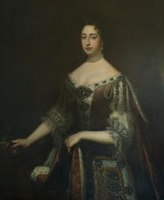 Portrait of Queen Mary II of England (1662 - 1694)
 Mary was born on April 30, 1662, during the reign of her uncle, Charles II. Her father, James, was first in line to the throne but he was Catholic, which made him unpopular in England. As a result, Charles required Mary to be raised as a Protestant. Three years later, James succeeded Charles, but he was deposed in the Glorious Revolution of 1688, where Mary and her husband as well as first cousin, William of Orange, succeeded him in 1689. Mary was devoted to her husband and reluctant to assume power in his absence, but she proved to be a strong and capable monarch when the need arose. The couple had no children; there is speculation that an early miscarriage permanently impaired Mary’s ability to have children. She was extremely devout and dedicated much of her time to ecclesiastical affairs. In addition, Mary endowed the College of William & Mary in 1692, helped found the Society for Promoting Christian Knowledge, and the Royal Hospital for Seamen. Mary was tall and apparently fit, but in 1694 she contracted smallpox. She died on December 28, 1694. William was devastated and reigned on as sole monarch until his death in 1702.
-
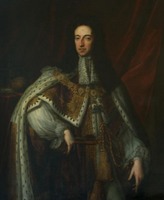 Portrait of King William III of England (1650 - 1702)
-
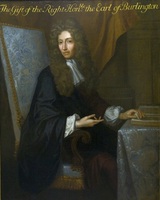 Portrait of Robert Boyle
 Donated by the sitter’s nephew, the Third Earl of Burlington, in 1732, this portrait of celebrated scientist Robert Boyle was the first work of art acquired by The College of William and Mary. Boyle was renowned for the discovery, later known as “Boyle’s Law,” of the mathematical relationship between the pressure and volume of a gas. Upon his death, funds from his estate at Brafferton Manor in Yorkshire, England, founded the first Indian school in the New World, located at the College and named “Brafferton” after Boyle’s manor house. James Worsdale, a student of Sir Godfrey Kneller, based this work on a 1689 portrait of Boyle by Johann Kerseboom, a German-born artist active in England in the late 17th century and the first decade of the 18th century.
-
 Antique Armor 14
 "Japanese Samurai armor, presented to President Theodore Roosevelt by the Emperor of Japan after the Portsmouth Peace Conference, ending the Russo-Japanese war, September 5, 1905. The color of this armor indicates a samurai of great authority. Heraldic (mons) on the armor belonged to several important families such as the Hosokawa, Ogasawara and Shibata. The helmet bowl dates from 1532-1555 and was made by Miochin Nobufusa, a pupil of the most famous armorer, Nobuiye. The face mask (mempo) was made by Miochin Munekatsu working about 1800-1854. The complete suit was probably mounted between 1850-1875."
-
 Twice Captured Presentation Sword
 This sword was first presented to C.W. Brandt by the 1st New York Veteran Cavalry. It was subsequently captured and presented to Lieutenant Colonel John S. Mosby by Lieutenant A.E. Richards on March 10th, 1864. The sword was recaptured and presented to Colonel H.S. Gansevoort by the 13th New York Cavalry in September 1864.
The blade of this Model 1850 Presentation Sword is long, curved, and single edged. It is decorated on both sides with floral and scroll designs in silver chasing. On the obverse is an eagle holding a banner that reads, "E PLURIBUS UNUM". On the reverse is a "U.S." monogram in place of the eagle. The grip is cylindrical and wrapped with gilt wire 11 times in a spiral. The pommel is shaped like a traditional Model 1850 sword, and scroll designs are featured its edges. The knuckle guard and counterguard are decorated with scroll designs. The quillon curls down to the blade in a scroll design.
The scabbard has three mounts. The first two are small and thin, and feature casts of oak sprays and acorns and the drag features a scroll design. There are four inscriptions on this scabbard, one on the obverse and three on the reverse. Two of the inscriptions (obverse and left reverse) bear the name of the sword's original owner “Presented by / Co.L. 1st N.Y. Vet. Cav. / as a mark of Esteem / to C.W. Bryandt.” The next, (center reverse), reads "Captured March 10th 1864 / and Presented / by Lt. A.E. Richards / to / Lt. Col. John Singleton Mosby", and the last inscription, (right reverse), reads "Recaptured / Sept 1864 / by the 13TH N.Y. Cavalry / Col. H.S. Gansevoort". There are two carrying rings on the scabbard, one on the right side of the top two mounts.
Maker of hilt - Hunt & Goodwin
Maker of blade - W. Clauberg
-
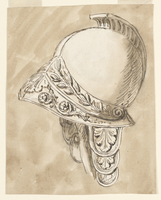 Helmet
 A pen and ink drawing of a Greek and Roman Helmet. Giuseppe Barberi captured the metalwork of the piece of armor.
-
 Adam Stephen’s Waistcoat and Gorget
 Uniform waistcoat worn by Lieutenant Colonel Adam Stephen during the French and Indian War. Stephen was George Washington’s Second-in-Command of the Virginia Regiment.
The Virginia Regiment saw active service in Western Pennsylvania from 1754 to 1759. In 1755, the officers of the Virginia Regiment received orders from Washington to provide themselves with a "Suit of Regimentals" of good blue cloth. The coat was to be faced and cuffed in scarlet and trimmed with silver; they were to wear blue wool breeches and a scarlet wool waistcoat with silver lace. The waistcoat which extended to below the hips was typically worn over a plain shirt.
A gorget is part of the full dress uniform. It is a vestige of plate armor, symbolizing rank and authority.