-
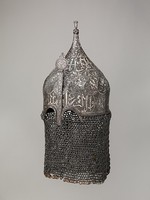 Helmet with Aventail
 This especially attractive and well preserved turban helmet retains the mail aventail that protected the lower half of the face and neck. The aventail is fixed with a lead seal stamped with the mark used in the Ottoman arsenals, an indication that this example, like the other turban helmets also in the Museum's collection (acc. nos. 04.3.209, .210, .214, .457, .462; 36.25.109), passed into Turkish possession as booty with the Ottoman conquest of Iran and the Caucasus.
At least one turban helmet decorated in a style comparable to this example bears the name of Farruhk-Siar (reigned 1464–1501), ruler of Shirvan in the Caucasus. Such evidence suggests that this helmet is also of Shirvan manufacture.
-
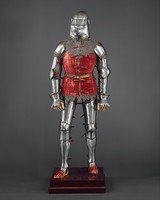 Armor
Armor This armor was assembled and restored under the direction of Dr. Bashford Dean in the 1920s, when it was part of his private collection. It consists of elements mostly from Chalcis, such as those exhibited in the vitrines to the left and right. Dean's intent was to present a full armor of the style worn about 1400, a period from which no complete armors survive. Distinctive features are the early form of brigandine (a torso defense constructed of plates riveted inside a doublet) and the brass borders on the edges of the exposed plates of the other parts of the armor. Portions of the brass at the top edge of the left cuisse (thigh defense), the lower edges of the right greave (lower leg defense), and the visor are genuine; the remainder of the brass is restored. The helmet, a visored bascinet, is not from Chalcis. The velvet covering of the brigandine is a restoration of the early twentieth century.
-
 Shield (Tiye)
 A sheild made by and used by the Mukabuki village Papua New Guinea people, Upper Sepik, April River Papua New Guinea
-
 First Class of Female Astronauts
 The first female astronaut candidates accepted in 1978. From left to right are Shannon W. Lucid, Margaret Rhea Seddon, Kathryn D. Sullivan, Judith A. Resnik, Anna L. Fisher, and Sally K. Ride. They were part of the group known as the 'Thirty-five New Guys' since it was NASA's first astronaut program in eight years.
-
 Jacqueline Cochran
 Jacqueline Cochran was the first woman to break the sound barrier. Known as the "Speed Queen" she was a well known racing pilot and was part of the Women's Auxiliary Army Corps (WAAC) and Women Airforce Service Pilots (WASP). She later worked as a consultant for NASA.
-
 Pearl I. Young
 Pearl Young was the first woman to work in a professional capacity for NACA (National Advisory Committee for Aeronautics,) the preceding organization to NASA. She designed and implemented a technical writing system that is still used today.
-
 Astronaut Eileen Collins at the Pilot's Station on Shuttle Discovery
 Eileen Collins was the first woman to pilot a space shuttle in 1995. She flew on mission STS-63 on the shuttle Discovery.
-
 Women Scientists at NASA in January 1959
 From left to right: Lucille Coltrane, Jean Clark Keating, an aerospace engineer, Katherine Collie Speegle, a mathematician, Doris 'Dot' Lee, Ruth I. Whitman, an engineer and Emily Stephens Mueller. Both Lucille Coltrane and Emily Mueller were known as "Computers," people who performed mathematical calculations by hand.
-
 Astronauts Jan Davis & Mae Jemison on STS-47
 Mission Specialists Jan Davis & Dr. Mae C. Jemison on board the space shuttle Endeavor. Dr. Jemison was the first African American woman in space.
-
 Ride on the Flight Deck
 In 1983, Mission Specialist Sally K. Ride was the first American woman in space on the space shuttle Challenger.
-
 Dr. Nancy Grace Roman, Astronomer
 Dr. Roman was the first Chief of Astronomy in NASA's Office of Space Science. She was also the first female to hold an executive position at NASA. Many know her as the "Mother of Hubble" for role in the planning of the Hubble Space Telescope.
-
 Autumn Afternoon, Rocky Mountains
-
 The Teton Range
 As Albert Bierstadt claimed the Rocky Mountains and the Sierra Nevada for his art, so Moran made the Yellowstone region and the Grand Canyon his signature subjects. His dazzling paintings and illustrations of Yellowstone led directly to its designation in 1872 as the first national park. A native Briton and an ardent admirer of the English painter J. M. W. Turner, Moran orchestrated dynamic form and prismatic color into visual anthems to America’s scenic splendors—such as this dramatic view of the Tetons, located just south of Yellowstone and characterized by one of the country’s most picturesque mountain profiles.
-
 Mount Brewer
-
 Mount Williamson, Sierra Nevada, from Manzanar, California
-
 Winter, Yosemite Valley
-
 Winter Coast
 Homer’s tiny hunter, carrying a goose on his back, is dwarfed by the massive shelving rocks and pounding surf of Prout’s Neck, Maine. Like the increasingly solitary artist, the human figure appears alone, hardy, and ephemeral.
-
 College of William and Mary Royal Charter
 This 1693 contemporary copy of Charter was probably made for the personal reference of Sir Edmund Andros. Purchased by the College in 1970s
-
 Copy of Sir Robert Boyle's Will
-
 Cascade Mountain Landscape
-
 Canadian Rockies (Lake Louise)
 During his travels in the American and Canadian West, Bierstadt made oil sketches such as this one, which he used, back in his New York studio, for reference in concocting the huge, carefully detailed panoramic scenes that brought him critical acclaim during the 1860s and 1870s. By the end of the century, American viewers had come to appreciate the more modest landscape observations of Barbizon and Impressionist painters, and Bierstadt’s sketches were themselves valued as fresh, direct records of the places he had visited.
-
 The Rocky Mountains, Lander's Peak
 This painting is the major work that resulted from the artist's first trip to the West. His intention to create panoramic views of the American frontier was apparent by December 1858, just before he embarked on the trip. In early 1859 he accompanied a government survey expedition, headed by Frederick W. Lander, to the Nebraska Territory. By summer, the party had reached the Wind River Range of the Rocky Mountains in what is now Wyoming. Bierstadt dubbed the central mountain in the picture Lander's Peak following the colonel's death in the Civil War. This was one of a number of large works painted after Bierstadt's return from these travels. It was completed in 1863, exhibited to great acclaim, and purchased in 1865 for the then-astounding sum of $25,000 by James McHenry, an American living in London. Bierstadt later bought it back and gave or sold it to his brother Edward.
-
 Heart of the Andes
 This picture was inspired by Church's second trip to South America in the spring of 1857. Church sketched prolifically throughout his nine weeks travel in Ecuador, and many extant watercolors and drawings contain elements found in this work. The picture was publicly unveiled in New York at Lyrique Hall, 756 Broadway, on April 27, 1859. Subsequently moved to the gallery of the Tenth Street Studio Building, it was lit by gas jets concealed behind silver reflectors in a darkened chamber. The work caused a sensation, and twelve to thirteen thousand people paid twenty-five cents apiece to file by it each month. The picture was also shown in London, where it was greatly admired as well.
-
[Untitled]
-
 Discoidea, scheiben-strahlinge
 Lithograph, Tafel 11, Heliodiscus from Haeckel's Kunstformen der Natur.