-
 Actiniae, seeanemonen
 Lithograph, Tafel 49, Heliactis from Haeckel's Kunstformen der Natur.
-
 Thalamophora, kammerlinge
 Lithograph, Tafel 2, Globigerina from Haeckel's Kunstformen der Natur.
-
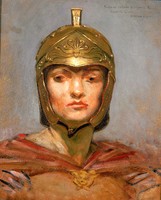 Statute Law - Helmet for Figure of "Force"
 A study done in preparation of a mural.
At the turn of the twentieth century, American artists decorated important public buildings with colorful and theatrical murals, images that were meant to enhance architectural spaces and impart lessons of good taste and moral values. In 1898 the National Society of Mural Painters nominated Kenyon Cox and nine other members to create murals for the new state appellate court building in New York City. The space given to Cox was the most challenging: Only four feet high and thirty-five feet long, it had two smaller, angled areas at each end. He chose to paint allegorical figures symbolizing the principles of law. This study for the figure of Force shows a woman wearing a helmet and looking out with a formidable expression; it is the kind of detailed sketch Cox made of each figure before beginning the mural. (Morgan, Kenyon Cox, 1856-1919: A Life in American Art, 1994)
-
 Man and Armor
 Two medieval figures in a crypt. One skeleton and one corpse in armor are stacked one atop the other in their niches. Reminiscent of the Crusades and other Medieval imagery from the 15th century.
-
 Annie Easley, Computer Scientist and Mathematician
 Annie Easley was a mathematician, computer scientist and rocket scientist. She was one of the first African American women to work at NASA as a computer scientist. Her career spans 34 years and involves being a team leader in the software development for the Centaur high-energy upper rocket stage. She also helped develop and implement computer code that analyzed alternative power technologies.
-
 Rocket Girls and the Advent of the Space Age
 The "human computers" at the Jet Propulsion Laboratory (JPL) campus. Among them is Janez Lawson, the first African American hired into a technical position at JPL. The work of these women helped launch the first U.S. satellite, Explorer 1.
-
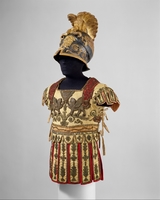 Costume Armor and Sword in the Classical Style
 This pseudoclassical armor was created to be worn at an event and not on the battlefield.
Pageants in pseudoclassical dress were popular in Europe from the sixteenth through the eighteenth century. An elaborate costume of the kind displayed here may have been worn for a theatrical performance or a court festivity, such as a ball or carousel in which the theme was taken from classical mythology or history.
The embroidered tunic represents an embossed bronze cuirass of the type worn by high-ranking Roman officers. The stylized Greek helmet is richly decorated with mythological and allegorical figures. Inside the helmet is the original paper label that identifies the Parisian maker as Halle dit Mercier and advertises his ability to provide helmets, shields, masks, costumes, and scenery for any occasion.