-
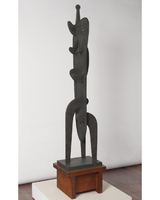 Gregory
 Gregory is inspired by Gregor, the main character in Franz Kafka’s absurdist novella, The Metamorphosis. After waking one morning to find he has become a large insect, Gregor’s life slowly deteriorates as the last remnants of his human life are lost and his family turns on him, burdened by the responsibility of caring for the house’s former breadwinner while hiding him from outsiders. Gregor, though at first casually inconvenienced by his fate, cannot live with the discomfort he has brought to his family and ultimately dies to avoid furthering burdening them further.
-
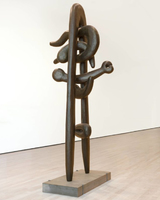 Cronos
-
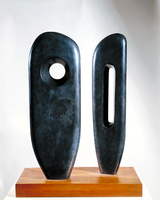 Two Figures (Menhirs)
 The title conflates Hepworth's recurrent theme of two figures in harmonious conjunction with her interest in the ancient standing stones that can be seen in the landscape around St Ives. Appropriately, this work is carved from Cornish slate. The artist's first slate sculptures were carved from the bed of an old billiards table. The larger figure contains a striking fossil, which was created by a small creature swimming through the silt that solidified, preserving the pattern of eddying mud in the stone.
-
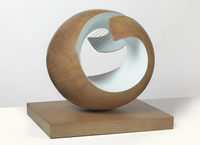 Pelagos
 Pelagos (‘sea’ in Greek) was inspired by a view of the bay at St Ives in Cornwall, where two stretches of land surround the sea on either side. The hollowed-out sculpture has a spiral form resembling a shell, a wave or the roll of a hill. Hepworth wanted the taut strings to express ‘the tension I felt between myself and the sea, the wind or the hills’. She moved to Cornwall with her husband, painter Ben Nicholson in 1939 and produced some of her best-known sculpture inspired by its wild landscape.
-
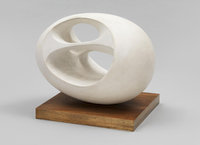 Oval Sculpture No. 2
-
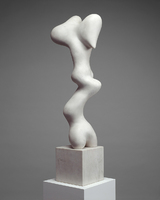 Growth (Croissance)
-
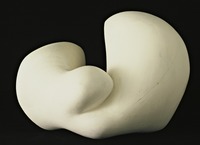 Human Concretion
-
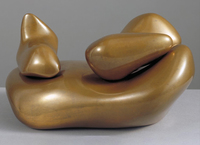 Sculpture To Be Lost in the Forest
(Sculpture à être perdue dans la forêt)
Sculpture To Be Lost in the Forest
(Sculpture à être perdue dans la forêt) In the 1920s and 1930s Arp developed a type of biomorphic sculpture that suggested a parallel between artistic creativity and creation in nature. The shapes in his work evoke worn pebbles, buds and other natural forms. He created these sculptures using a quasi-automatic process of sanding away at a plaster model until he was satisfied with the shape. ‘I work until enough of my life has flowed into its body’, he said. His efforts to link his work with nature included placing sculptures in the forest near his home at Meudon, where they could be discovered by unsuspecting passers-by.
-
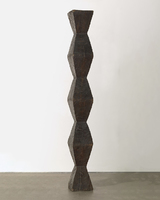 Brancusi, Constantin, 1876-1957. Endless column
 This sculpture is the earliest extant Endless Column. In preceding years Brancusi had used a single or double pyramid as a base for his sculpture, but he eventually came to see this abstract construction as a fully realized work in its own right. Carved from oak, this succession of pyramids forms a rhythmic and undulating geometry that suggests the possibility of infinite expansion. Like other favorite motifs, this was one that Brancusi would return to over the course of his career. In the mid-1920s, he carved an Endless Column for his friend the photographer Edward Steichen that rose more than twenty-three feet. And in 1937 Brancusi erected a steel Endless Column in Tîrgu-Jiu, Romania, that soared more than ninety-eight feet into the air. That Endless Column, his last, was part of a larger sculptural ensemble that included The Gate of the Kiss and Table of Silence, which formed the artist’s only foray into public sculpture.
-
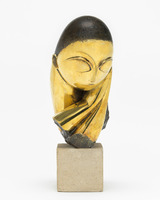 Mlle Pogany
 This sculpture is a portrait of Margit Pogany, a Hungarian artist who sat for Brancusi several times in 1910 and 1911 while she was in Paris studying painting. Shortly after her return to Hungary, Brancusi carved a marble Mlle Pogany from memory, then made a plaster mold of the work, from which he cast four additional versions, including this one, in bronze. In representing its subject through highly stylized and simplified forms, the work was a significant departure from conventional portraiture. Large almond-shaped eyes overwhelm the oval face, and a black patina represents the hair that covers the top of the head and extends over the elaborate chignon at the nape of the neck. As with other motifs, this was a subject Brancusi would return to and rework in the years to come.
-
 Ommah
Ommah In 2005, the year before his death, Nam June Paik created Ommah (""mother"" in Korean), his last work of video sculpture, a genre that he invented in the early 1960s. The work is a moving summary as well as a lighthearted look back at a long and winding career.
In Ommah, a traditional robe that might have been worn by a well-off Korean boy some 100 years ago hangs nearest to the viewer. Through its lightweight silk, images on an LCD TV monitor can be seen, but not without the irritation of a moiré pattern caused by the interplay of the two ""screens."" The monitor plays a program lasting several minutes and looping continuously. Three Korean American girls in traditional costumes dance, play ball, beat a drum, and ride in a toy car, seemingly carefree but carefully choreographed by Paik. The back-ground imagery includes close-up views of early video games, footage from TV shows, and material from Global Groove, the video Paik made for WNET-TV in 1974, all manipulated using a high-tech version of the color video synthesizer Paik coinvented around 1970. The music includes ambient sounds of the studio, both straight and processed, and snippets from Paik's own experimental music tapes of the 1950s.
As stable and iconic as this cruciform work appears, our physically moving before it is vital as we pass back and forth, trying to peer through or around the robe. Paik attacked the passivity that he felt television imposed on viewers. Through endless play with the medium, he reclaimed the ""boob tube"" as an expressive, democratic tool. A Fluxus-inspired trickster crossing high culture with low, Paik never lost the homemade, improvised quality of his earliest experiments.
To complement this gift of the Collectors Committee, Paik's nephew Ken Hakuta has donated an early work. Untitled (Red Hand), 1967, also employs a found antique as a screen (in this case a 19th-century Japanese scroll painting) through which light (in this case a blinking bulb) is projected. The bulb illuminates a handprint, presumably the artist's own, made on the glass of the frame. The scroll's comical figure with bulging eyes combines with these other elements in a humorous meditation on authorship and scavenger hunting, technology and tradition. Together these two works constitute a landmark acquisition: they are the first sculptural objects by Paik to enter the collection, and Ommah is a key addition to our nascent collection of works in time-based media.
-
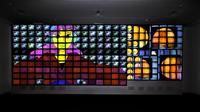 Megatron/Matrix
 Megatron Matrix is roughly the size of a billboard and holds 215 monitors. The video—augmented by a loop of unrelated soundbites—mixes images from the Seoul Olympics with Korean folk rituals and modern dance. Smaller clips play simultaneously on multiple monitors, while larger, animated images flow across the boundaries between screens, suggesting a world without borders in the electronic age.
Paik sorted the monitors into two distinct sections. The Megatron conveys the vast reach of the media, while the smaller section, the Matrix, emphasizes the impact on each of us. In Matrix, Paik arranged the monitors so that the images seem to spiral inward around a lone screen showing two partially nude women. He may be suggesting that our bodies are our primal connection to the world, but the effect on the viewer is of being assaulted by "too much information."
In the early 1960s, Paik began incorporating televisions into his collaborative performance pieces with American dancers, musicians, and artists. Today, the fusion of pop music, commercial culture, and nationalist symbols captures Paik's story and that of millions around the world. Paik's prophetic awareness of the power of television has been borne out in our "plugged-in" age, when any kind of art or entertainment is available on our screens all the time.
-
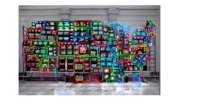 Electronic Superhighway: Continental U.S., Alaska, Hawaii
 When Nam June Paik came to the United States in 1964, the interstate highway system was only nine years old, and superhighways offered everyone the freedom to "see the U.S.A. in your Chevrolet." Walking along the entire length of this installation suggests the enormous scale of the nation that confronted the young Korean artist when he arrived. Neon outlines the monitors, recalling the multicolored maps and glowing enticements of motels and restaurants that beckoned Americans to the open road. The different colors remind us that individual states still have distinct identities and cultures, even in today's information age. Paik augmented the flashing images "seen as though from a passing car" with audio clips from The Wizard of Oz, Oklahoma, and other screen gems, suggesting that our picture of America has always been influenced by film and television. Today, the Internet and twenty-four-hour broadcasting tend to homogenize the customs and accents of what was once a more diverse nation. Paik was the first to use the phrase "electronic superhighway," and this installation proposes that electronic media provide us with what we used to leave home to discover. But Electronic Superhighway is real. It is an enormous physical object that occupies a middle ground between the virtual reality of the media and the sprawling country beyond our doors.
-
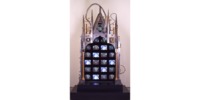 Technology
-
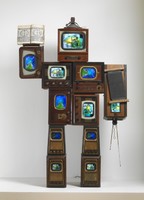 Li Tai Po
-
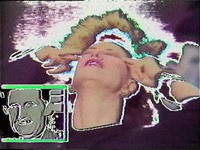 Good Morning Mr. Orwell
 Good Morning Mr.Orwell is an edited version of Paik's first international satellite "installation," which was held on New Year's Day 1984. Paik's transcultural satellite extravaganzas link different countries, spaces, and times in often chaotic but entertaining collages of art and pop culture, the avant-garde and television. Good Morning Mr.Orwell, which Paik saw as a rebuttal to Orwell's dystopian vision of 1984, linked France, Germany and the U.S. The event featured vibrant performances by Laurie Anderson, Merce Cunningham, Peter Gabriel and Allen Ginsberg, among many others. Paik coordinated the event and designed the TV graphics that connected the various live and pre-recorded segments. This project can be seen as a development of Paik's thinking on the potential of satellite communication, as proposed in A Conversation, and realized with his typical pastiche of art, entertainment, and crosscultural juxtapositions.
-
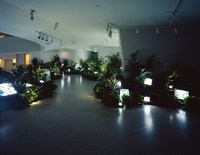 TV Garden
 No artist had a greater influence in revealing the artistic potential lurking behind television’s flickering facade than Nam June Paik. Commonly hailed as the father of video art, Paik reshaped perceptions of the electronic image through a prodigious output of manipulated TV sets, live performances, global television broadcasts, single-channel videos, and video installations. His career took him from Asia through Europe to the United States, and Paik’s complex media-based art grew out of his early interests in electronics, as well as his foundations in performance and music. Arriving in New York in the mid-1960s, he joined a new generation of artists that was altering the ways in which one interacts with the moving image. Paik became a prominent member of the Fluxus movement, whose principles included the transformation of quotidian actions—like the buttoning and unbuttoning of a coat, as seen in his video Button Happening (ca. 1965)—into art. Quickly emerging at the forefront of this movement, Paik also sought to involve the viewer as an active participant in his performances and installations, and he often introduced elements of surprise and the unfamiliar.
TV Garden, one of his seminal installations, illustrates Paik’s profound grasp of technology’s capacity for composition and the new aesthetic discourse that he helped to create. To enter the piece is to experience an uncanny fusion of the natural and the scientific, as hidden amid an undergrowth of live plants are video monitors of various sizes. All are playing the artist’s 1973 collaboration with John J. Godfrey, Global Groove, which montages performers from around the world into a gyrating visual mix, and the videotape’s sound track serves as musical and spoken counterpoint to the monitors’ flickers of light. TV Garden set a new standard for immersive, site-specific video installations. Restaged for the artist’s exhibition at the Guggenheim Museum in 2000, its influence can be seen decades later in ambient, room-sized installations by such artists as Gary Hill and Bill Viola.
For Paik, the artist should not be limited in seeking new forms of creative expression, but rather the potential for innovation must be continually reimagined. Just as Paik reconceived broadcast television in the 1960s and 1970s in order to “turn it inside out” and deliver a fresh take on this means of communication, Paik turned to laser technology as a novel type of sculptural and installation art at the beginning of the 21st century. He continued to dismantle customary ways of seeing and expand the parameters of art making throughout his career.
-
 Buddha Watching TV
 "“The real issue implied in “Art and Technology” is not to make another scientific toy, but how to humanize the technology and the electronic medium, which is progressing rapidly—too rapidly.” —Nam June Paik
Paik, undoubtedly the single most important figure in the history of video art, established the medium in the early 1960s. Buddha Watching TV comes from one of his most celebrated video sculpture series. Paik created the original concept in 1974 and made this example in 1997.
Here a stone Buddha head from Indonesia, partially embedded in dirt and signed dramatically across the back by Paik in Chinese and English, appears to observe itself on television. A live image of the unchanging head is continuously relayed to the monitor by the closed-circuit camera on the tripod. The Buddha thus generates and receives its own image in an infinite temporal loop, updating the act of contemplation for the age of technology."
-
 A Tribute to John Cage
 "A Tribute to John Cage is Paik's homage to avant-garde composer John Cage. A major figure in contemporary art and music, Cage was one of the primary influences on Paik's work, as well as his friend and frequent collaborator. In this multifaceted portrait, Paik creates a pastiche of Cage's performances and anecdotes, interviews with friends and colleagues, and examples of Paik's participatory music and television works that parallel Cage's strategies and concerns. The methodology and philosophies that inform Cage's radical musical aesthetic — chance, randomness, the democratization of sounds — are evident as he performs such seminal pieces as 4'33"" (of complete silence) in Harvard Square, or throws the I Ching to determine performance sites. Among the collage of elements included in this work are segments from Paik's Zen for TV; Paik and Charlotte Moorman in early performances, including the TV Bra; and anecdotes from composer Alvin Lucier.
Host: Russell Connor. Guest: Alvin Lucier. Performers: John Cage, Marianne Amacher, Richard Teitelbaum, Pulsa, Charlotte Moorman, David Behrman, David Tudor. Excerpts of work by Cathy Berberian, Jud Yalkut, Francis Lee, David Rosenboom, Jackie Cassen, Stan VanDerBeek, Alfons Schilling. Produced by the New Television Workshop and the TV Lab at WNET/Thirteen."
-
 Participation TV
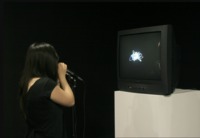
 This work is one of the 13 experimental televisions shown in Paik’s first solo exhibition in Wuppertal, Exposition of Music—Electronic Television (Germany, 1963). Its earlier form was sheer acoustic, while the later version of Participation TV visualized amplification of sound. When someone speaks or makes a sound into the microphone, the monitor shows several images. The work housed by the Nam June Paik Art Center was re-made in 1998. When someone makes a sound into the microphone, the acoustic signals are transformed into fine electronic signals, which are amplified and displayed as visual patterns. According to the rise and fall and volume of the sounds made by the audience, the lines split into three colors (red, green, and blue) are transformed into images that are not able to be predictable nor repeat themselves.
-
 "The Dinner Party---Primordial Goddess Plate"_Judy Chicago
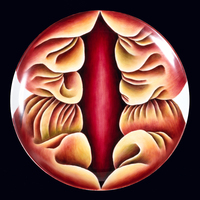
 Judy Chicago’s original concept for The Dinner Party was multi-faceted in that her goal was to introduce the richness of women’s heritage into the culture in three ways; a monumental work of art, a book and a film because she had discovered so much unknown information.
-
 Introduction to a Critique of Urban Geography
 descript Les Lèvres Nues #6 (September 1955)
-
 “Wild Roses"_Vincent Van Gogh
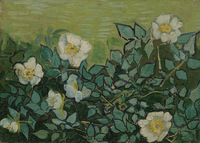
 This picture of wild roses may look very pleasant and peaceful, but Van Gogh was actually suffering a severe mental crisis at the time. He had entered the psychiatric clinic in Saint-Rémy-de-Provence as a voluntary patient, hoping to find peace there. As soon as he could, he went out into the gardens to paint or draw. Van Gogh has painted the fragile blossoms naturalistically. But he has treated the green leaves differently. He has turned them into flat areas of plain colour surrounded by heavy blue outlines.
-
 "Ecce Ancilla Domini" (The Annunciation)_Dante Gabriel Rossetti
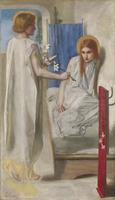
 Inspired by the work of early Renaissance artists such as Botticelli (1445-1510) and Fra Angelico (1387-1455), Rossetti sought in this work a radical reinterpretation of the Annunciation. Traditionally the Virgin was depicted in studious contemplation, reading a missal at a prie-dieu; but here Rossetti shows her rising awkwardly from a low bed, as if disturbed from sleep, while the Angel Gabriel presents her with a white lily. Both figures are dressed in white, a symbol of the virgin's purity, and the angel's role as the messenger of god is emphasised by the small white dove hovering beside him, signifying the presence of the holy spirit. Rossetti used several sitters for his figures, including his brother, William Michael, for the Angel and his sister, Christina, for the Virgin. A companion piece showing the Virgin's death was planned, but never begun. This partly explains the tall narrow shape of the picture, which was intended as part of a diptych. Rossetti intentionally restricted his palette almost entirely to white and the three primaries. The colour blue, symbolic of heaven, is traditionally associated with the Virgin and red symbolises the blood of Christ. Rossetti even sought a red-haired model for the Virgin's head. The composition is carefully thought out: the vertical division of space, made by the blue hanging and the edge of the bed, falls almost on the Golden Section. The dove and the lily, with one bud still to break, move across this division and are the instruments of conception. Rossetti has written the date, 'March', at the bottom of the canvas, perhaps to signify the month in which the Feast of the Annunciation is held. The original frame was also inscribed with Latin mottoes, copied from a brass rubbing owned by a fellow member of the Pre-Raphaelite Brotherhood, F.G. Stephens (1828-1907).
-
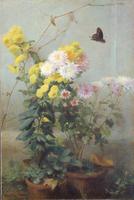 "Autumn Sunshine"_George Cochran Lambdin
 George Cochran Lambdin painted this work while living in Philadelphia's Germantown section,an area famed in the late nineteenth century for its gardens. Lambdin turned his attention to paintings of flowers in 1870, probably inspired by the English Pre-Raphaelites, who believed that a closer study of nature resulted in paintings that were more spiritually truthful. In Autumn Sunshine, Lambdin did not use the traditional composition of a vase of flowers on a tabletop. Instead, his painting of potted plants on the floor of a greenhouse captures the flowers as they are still growing, creating a more natural image. The soft tones of yellow and pink emphasize the delicate texture of the chrysanthemum's petals, while the dead leaves, together with the thin vine in the background, enhance the feeling of having captured a fleeting moment in nature.