-
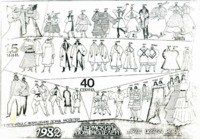 Leipzig Trade Fair Design Sketches
 This is a series of designs, the top pieces intended to represent the culture of the 15 Soviet republics. The bottom series are modern pieces. These pieces are for designs featured at the 1982 Leipzig International Trade Fair's fashion show.
-
 Designs from the Kirghiz House of Fashion Design of Clothes, Ministry of Light Industry
 This photograph shows modern designs for fashion by the Kirghiz House of Fashion.
-
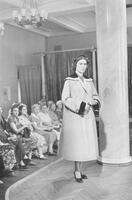 Fashion Show
 This photograph shows a fashion show in Moscow with a civilian audience.
-
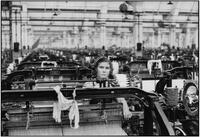 Textile Factory
 This is a photograph of a textile working at a weaving station. The textile worker is the only worker present in the factory in the line of the photographer's view.
-
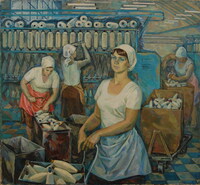 Spinner of the Kamyshin Cotton Mill, G. F. Lavrova, is a recipient of the Order of the Red Banner of Labor.
 This painting depicts a textile worker who received an award for her service in the textile industry.
-
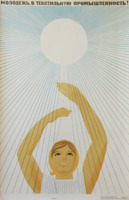 Youth, Go into the Textile Industry!
 This poster advertises for more youth in the textile industry.
Translation: Youth, in the textile industry!
-
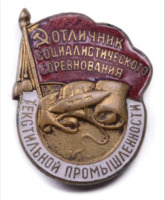 Commemorative Pin for Textile Industry Work
 This is a commemorative pin awarded for textile industry work
Translation: Honored Socialist Competition. (in the) Textile Industry.
-
 Red Army Soldiers on Skis
 A flannel with the pattern of seemingly women workers on machinery.
-
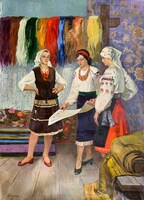 New Designs of Soviet Fabric
 This painting depicts the review of new Soviet designs done by three textile workers dressed in traditional attire. The artist is not found to be a socialist realist artist, but the art style alongside his art education suggests a heavy influence in his style.
-
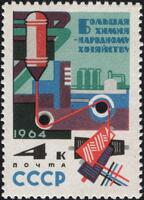 Big Chemistry for the National Economy
 This stamp commemorates the Soviet Union's textile industry's adoption of synthetic fibers in the 1960s.
Translation: Big chemical industry. 1964. 4 k (kopecks) Post office USSR.
-
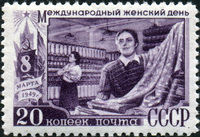 International Women's Day, March 8. Women in Industry
 This stamp is part of a series of International Women's Day stamps from 1949. The image given is dedicated to women who worked in the textile industry.
It is unknown which Goznak factory produced this item as there are multiple geographic locations.
Translation: International Women's Day. 8 March 1940 g. (year). 20 kopecks. post office.
-
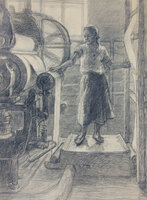 In the Weaving Industry
-
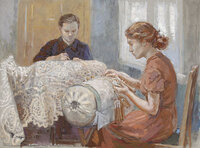 Lacemakers
 This drawing depicts lacemakers, an industry of textile making that the Soviet Union as both an art form and area of production. Between the 1950s and 1960s, Evgeny Ivanovich Komarov was producting art for national stamps, it is unknown if this is a piece of such work or a person artwork.
-
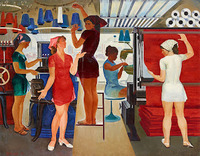 Weavers
 This painting depicts women at work in a weaving factory.
-
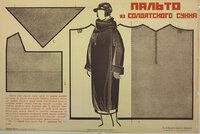 Coat from a Soldier's Cloth
 This Image presents the reuse of a military coat into a new design, with instructions on how to do so on the bottom left corner.
Translation: Coat from a Soldier's Cloth
-
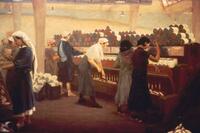 Textile Center in Kirovobad
 An oil painting depicting a fabric factory in Kirovobad, Azerbaijan.
-
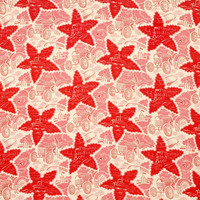 Industrial Print Textile
 A cotton printed design featuring tractors, trains, and steam boats within flower designs.
-
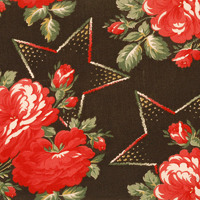 Stars and Roses Fabric Design
 This fabric design stands out from other patterns at the time for its softness. Other designs at the time either mirror the republics' traditional patterns, were part of the new constructivist movement, or followed the campy industry pattern trend. This pattern is still labeled as a Soviet imagery by The Museum of Ivanono Chintz in Russia, possibly by the use of stars and the color red in its pattern.
-
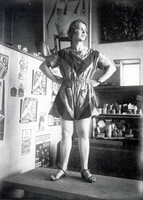 Varvara Stepanova in Her Own Unisex Sport Design
 Photograph of designer, Varvara Stepanova, in one of her own sport designs. This and her other experimental designs are examples of the created "Constructivism" which are designs for function and mass production, such as this unisex sport suit.
-
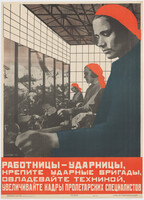 Women Shockworkers Poster
 A poster calling for an increase of women in skilled labor for production. The use of the red headscarf, already associated with the new liberated communist women of the Soviet Union, is applied directly into promotion of women into the labor force.
Translation: hardworking women workers, strengthen shock brigades, master equipment, increase the footage of proletarian specialists.