About
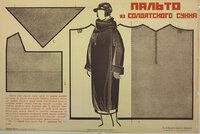
Coat from a Soldier's Cloth
This item was an early piece of the fashion and textile industry that was identifiably "Soviet."
Designed by Nadezhda Lamanova, a contributing designer to the constructivism movement, guiding the concepts of design, design purpose, and sustainable use of materials. This piece of her work was part of a series in a journal indended for teaching reconstruction and construction of garmnets.
(Bartlett, 2017)
(Nadezhda Lamanova, n.d.)
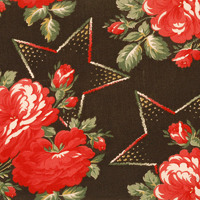
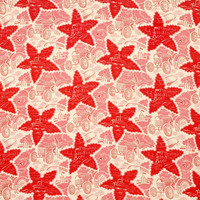
Stars and Roses Fabric Design
This fabric design stands out from other patterns at the time for its softness. Other designs at the time either mirror the republics' traditional patterns, were part of the new constructivist movement, or followed the industry-inspired pattern trend.
This pattern is still labeled as a Soviet imagery by The Ivanono Calico Museum, likely due to the use of stars and the color red in its pattern.
(Bryzgov, 2020)
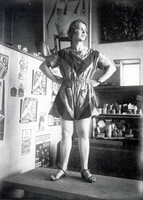
Varvara Stepanova in Her Own Unisex Sport Design
This is a photograph of Varvara Stepanova, a leading designer in the era of constructivist and productivist fashion and art in the early years of the Soviet Union's fashion and textile industries. This and her other experimental designs are examples of the constructivism movement, which are designs for function and mass production, such as this unisex sport suit.
(Bartlett, 2017)
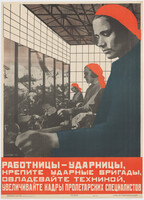
Women Shockworkers Poster
Although not depicting the textile industry, the image here is an example of the red headscarf, or kosynka, used in Soviet propaganda to depict the modern Soviet women. While depictions of women workers would continue to be represented wearing a kosynka, the use of the color red would disapear.

Red Army Soldiers on Skis
This textile print is a pieces of the construstivist movement's artistic styles revolving around depicting a short lived trend of depictions of industry works, or agiprop if viewed in the light of everyday propaganda.
The textile industry as related to printed fabrics saw a revival by the 1930s after the fall out of WWI and the civil wars.
(Allee, 2015)
(Bryzgov, 2020)
Industrial Print Textile
This pattern is a another piece of constructivist and agiprop textiles. Notice the representations of tractors, trains, and. steam ships hidden in the pattern's flowers. Such designs shows creativity in unsuspected creations of propaganda, or agitprop.
(Allee, 2015)
(Bryzgov, 2020)
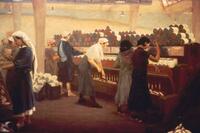
Textile Center in Kirovobad
This painting depicts a textile weaving factory in what is today Ganja, Azerbaijan. While this makes sense as a piece of propaganda, the art style differs from traditional social realism in both form and figure focus.
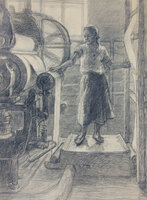
In the Weaving Industry
This is a sketch of a young woman or girl at work in the textile factory. Not much is known about this image, aside from the artist who was a war propaganda poster artist during World War II who continued to make postage stamps afterwards. As a curator, I found it interesting why the artist would chose to draw a woman or girl at work in the factory. Possibly for a mock up of a stamp or industry poster.
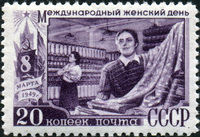
International Women's Day, March 8. Women in Industry
This postage stamp commemorates women in the textile industry as part of an International Women's day collection. It is unlike other uses of postage stamps to highlight industries, Soviet figures, and in relation to the era, the military and war. Such use of postage stamps as everyday political art pieces would be recognized as propaganda tools.
Notably, in 1949 fashion deisgn and production became centralized within the Light industry, combining designers with factories of pattern and textile production. This meant having fashion houses provide factories with needed information for mass producing garments.
(Gronow & Zhuravlev, 2015)
(Lebd & Morgulev, 2024)
(The Social and Political Statements Made Through Postal Stamps: A Study of Philatelic Propaganda, 2023)
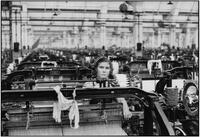
Textile Factory
Not much is found about the context of this photograph. Yet, this photograph does come from a notable French photographer, Henri Cartier-Bresson. who visited and taken many photos of Soviet everyday life and culture in 1954 for LIFE magazine.
(Phiesta, 2026)
(1954 | USSR by Henri Cartier-Bresson, 2025)

Fashion Show
Here is another Cartier-Bresson photograph from his 1954 visit to the Soviet Union. What might seem as a stark contrast to the Textile Factory photograph, the Soviet Union's fashion and textile industry, or Light industry, was actually exploring more western and luxury feel and aesthetic to their manufactured garments. The central house of design was in Moscow, as was the location of the photograph, however each republic had its own house as well.
(Phiesta, 2026)
(1954 | USSR by Henri Cartier-Bresson, 2025)
(Gronow & Zhuravlev, 2015)
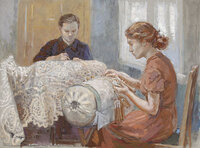
Lacemakers
This is an interesting piece in its representation of the lace industry. Lace as a delecate fabric may seem too frivelous for the Soviet Industry to prioritize, yet this industry served two purposes, one to preserve folk art, and also as an luxury export good.
This was an area for the Ministry of Local Industry to manage. What is interesting was that in this such area, people who worked from home, as pictured, were employed.
(Gronow & Zhuravlev, 2015)
(Кружево — Музейно-выставочный Комплекс, 2017)
Translation: ((Lace — Museum and Exhibition Complex, 2017)
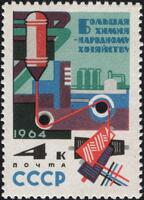
Big Chemistry for the National Economy
This postage stamp celebrates the development and production of synthetic fibers. Such promotion and use of synthetic fibers parallels the shortages of natural fibers alongside the decenteralizing away from the light industry, including the textile and clothing manufacturing industries. In part this was to promote trade, or trade relations.
(Bryzgov, 2020)
(Central Intelligence Agency, 1961)
(Gronow & Zhuravlev, 2015)
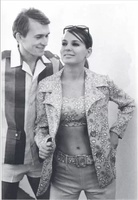
Designs from the Kirghiz House of Fashion Design of Clothes, Ministry of Light Industry
This photograph is representative of the development in the Light industry's focus of designs for clothing in the 1960s. Particularly in the later half of the 1960s, the industry gave focus for clothing aside from workwear and utility, bring more focus to fashionable and fun designs.
Notably, in 1967, Moscow hosted the International Fashion Festival.
(Gronow & Zhuravlev, 2015)
Weavers
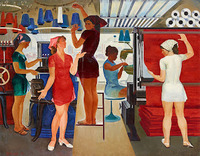
No information was founding on why Myagkov painted this scene. Considering Myagkov was part of the Soviet Union's Union of Artist and by the art style, inspiration by socialist realism is present.
A striking part of the painting is the repressentations of commadery. Such a theme is expanded on by a 2020-2021 project by London-based Estonian asrtist, Maria Kapajeva, where she highlights this history of sisterhood in the factories.
(Kapajeva, n.d.)
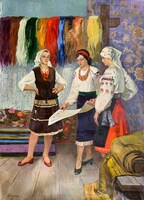
New Designs of Soviet Fabric
This painting has two contextes. One is the representation of traditional dress as worn by the figures. Another is the context of what they're looking at. At this time, production factories were required to only make designs by the Fashion design houses, not local designers. With little information about the art piece or the artisit intention, who was a Ukrainian artist working in the Russian region, we can create some interpretations of the traditional against the state ordered modern designs.
(Gronow & Zhuravlev, 2015)
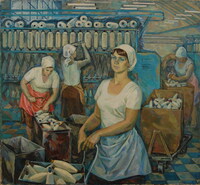
Spinner of the Kamyshin Cotton Mill, G. F. Lavrova, is a recipient of the Order of the Red Banner of Labor.
An interesting note about this painting is that is was created by a Union artist in the same year as the 60th anniversary of the Soviet Union was celebrated. This is also a commemerative paiting of a textile worker who recieved an award for her labor. Such context points to the purpose of the painting and the relationship between publicly valuing workers and what is propaganda.
(Petrova, 2025)
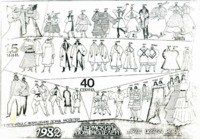
Leipzig Trade Fair Design Sketches
These designs were drawn out by the then director of the Perm fashion house for the Leipzip International Trade Fair. As this was done in the same year as the 60th anniversary, the designer was given the goal to showcase the cultural heritages with the 15 republics, as to show the friendship of peoples, but also presents modern Western-inspired designs.
(Abramov & Iuliia, 2018)
(Petrova, 2025)