-
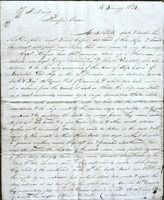 Captain Aaron Paddack's Letter Concerning the Wreck of the Essex
 A page of a letter written in cursive in black ink. On the morning of February 23, 1821, Captain George Pollard, Jr. and Charles Ramsdell were rescued by the whaleship “Dauphin” of Nantucket. That evening, Captain Zimri Coffin of the “Dauphin,” Captain Aaron Paddack of the whaleship “Diana” of New York, and Captain George Pollard, Jr. had dinner together aboard the “Dauphin.”
-
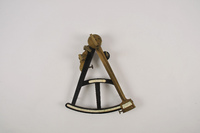 Quadrant
 A quadrant made of dark wood and brass with ivory inlays. Quadrants were used to determine a ship’s latitude by measuring the angle of the sun over the horizon at noon. William Bond, the “Essex”’s steward and one of its six Black crewmembers, was able to rescue the ship’s navigational equipment, which included two quadrants that were given to Captain George Pollard, Jr.’s and first mate Owen Chase’s whaleboats. However, using a quadrant was not as easy on a small, unsteady whaleboat as it was on a large, steady whaleship. Furthermore, a ship’s latitude and longitude are necessary to determine its position but the “Essex” did not have a chronometer, a timekeeping device that could be used to determine longitude and Captain Pollard did not know how to use the Lunar Distance Method to determine longitude.
-
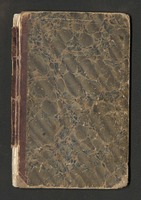 My First Voyage at Sea And Subsequent Loss of the Ship Essex
 A book with a green and blue marbled cover with worn edges and a damaged spine. Thomas Nickerson, the “Essex”’s cabin boy, wrote his own account of the sinking of the “Essex” in the 1870s on the suggestion of a writer, Leon Lewis, who may have been a guest at Nickerson’s boarding house. Although Nickerson sent Lewis the draft in 1876, it was not published until more than a century later. Some time before his death in 1920, Lewis gave the draft to his neighbor in Penn Yan, New York, Darius Ogden. Ogden’s grandson James N. Finch inherited the draft upon Ogden’s death around 1960. After reading the draft, Finch’s wife, Ann W. Finch, contacted whaling expert, author, and curator Edouard A. Stackpole, whose book on whaling, “The Sea Hunters,” she had read and from which she recognized the story of the “Essex.” Stackpole confirmed that the draft was Nickerson’s and the Nantucket Historical Association published it in 1984.
-
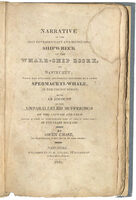 Narrative of the Most Extraordinary and Distressing Shipwreck of the Whale-Ship Essex
 The title page of “Narrative of the Most Extraordinary and Distressing Shipwreck of the Whale-Ship Essex” by Owen Chase. Almost one year to the day of the wreck of the "Essex," first mate Owen Chase published this book. Although Chase kept a log using the pencil and papers from his trunk while in the whaleboat, he is believed to have had a ghostwriter: fellow twenty-three-year-old Nantucketer, William Coffin, Jr., who attended Harvard instead of becoming a whaler. Chase’s “Narrative” does not reflect that he and second mate Matthew Joy convinced Captain Pollard not to return to Nantucket for repairs after the knockdown and not to sail for French Polynesia after the wreck of the “Essex.” While serving aboard the “Acushnet” of Fairhaven in 1841, Herman Melville met Chase’s son, sixteen-year-old William Henry Chase, who was serving aboard whaleship the whaleship "Lima" of Nantucket. Chase lent Melville a copy of his father’s “Narrative.” A decade later, Melville published “Moby-Dick.”
-
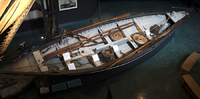 Whaleboat
 A narrow wooden boat with black rims, or “gunwales,” and a pale blue interior. Five narrow beams, or “thwarts,” go from one side of the boat’s body, or “hull,” to the other. Three oars rest on top of the gunwales and three more rest on top of the thwarts. A rope runs the front, or “bow,” of the boat to the back, or “stern,” where it wraps around a wooden post, called a “loggerhead,” before being placed in two wooden tubs, one large with a natural finish and one small painted the same shade of blue as the boat’s interior, on the floor of the boat in a coil. Almost thirty feet long, this whaleboat is slightly larger than the “Essex”’s whaleboats, which were twenty-five feet long. A whaleboat’s crew consisted of six men: the boatheader/harpooner, who pulled the oar at the bow of the boat and harpooned the whale; the bow oarsman, who oversaw pulling on the line tied to the harpoon to bring the boat close enough to the whale for the kill; the midships oarsman; the tub oarsman, who also managed and wetted the line as it ran out; the aft oarsman, who also managed the line as it was pulled on and hauled back into the whaleboat; and the captain, first mate, or mate, who steered the whaleboat with the steering oar, directed the oarsmen, and made the kill with a lance when the whale had tired itself out. The “Essex” carried five whaleboats when she departed on her fateful voyage: three on davits on the sides of the ship so that they could be prepared and lowered in a matter of minutes when whales were sighted, a spare on an overhead rack on the ship’s deck, and a spare on davits off the ship’s stern. On the fourth day of her voyage, two of her whaleboats were lost and one was badly damaged when she suffered a “knockdown.” The “Essex” approached a squall, “a sudden violent wind often with rain or snow,” with studding sails flying. These extra sails, temporarily attached to the fore topsail yard, were used to gain additional speed in fair weather. Rather than take in the studding sails and the large main topgallant sail, Captain George Pollard, Jr. ordered that the small fore and mizzen topgallant sails be taken in. The squall hit just as the “Essex” had begun to turn away from the wind. The force of the wind hitting the ship’s side knocked her over so that she was heeled over on her left, or “port,” side by almost ninety degrees and the waist and aft larboard boats were swept away by the sea. To prevent the ship from fully capsizing, Captain Pollard ordered his crew to release the lines used to hoist the sails, or “halyards,” and the lines used to control the sails, or “sheets,” to let the sails out so they could not catch wind. However when the ship returned upright, or “righted,” she began to sail backwards, crushing the spare whaleboat off the ship’s stern. Fortunately, the “Essex” resumed course before the pressure from being forced backwards could topple her masts or break her rudder but the loss of three whaleboats could make for a financially disastrous voyage. With fewer whaleboats, a whaleship might not fill her hold with oil before returning home. Each member of a whaleship’s crew was paid a share, or “lay,” of the money earned from the sale of the oil collected during the voyage: less cargo meant less money for the crew as well as for the ship’s owners. However, Owen Chase and Matthew Joy, the “Essex”’s first and second mate, respectively, convinced him to continue the voyage, insisting that they would be able to purchase whaleboats during their first provisioning stop in the Azores.
-
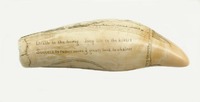 Engraved Sperm Whale Tooth 4
 A sperm whale’s tooth, inscribed with a poem. Whereas baleen was used in the manufacture of boxes, bags, trunks, canes, umbrellas, and garments such as corsets, bodices, and skirts, whale ivory and bone and walrus ivory had no commercial value and were given to the crew, who engraved or carved them during downtime. Scrimshaw was kept as a memento or gifted to loved ones upon return home. Images were not limited to scenes of whaling voyages - women, children, eagles, and buildings were popular subjects. Frederick Myrick produced 37 known carvings while serving aboard the “Susan” of Nantucket from 1826 until 1829, referred to as “Susan’s Teeth.” He was the first American whaler to sign and date his scrimshaw. All three Susan’s Teeth in the Nantucket Historical Association’s collection and all four in the New Bedford Whaling Museum’s feature this poem.
-
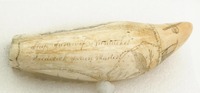 Engraved Sperm Whale Tooth 3
 A sperm whale’s tooth, inscribed with information about the ship on which it was made and her captain’s name. Whereas baleen was used in the manufacture of boxes, bags, trunks, canes, umbrellas, and garments such as corsets, bodices, and skirts, whale ivory and bone and walrus ivory had no commercial value and were given to the crew, who engraved or carved them during downtime. Scrimshaw was kept as a memento or gifted to loved ones upon return home. Images were not limited to scenes of whaling voyages - women, children, eagles, and buildings were popular subjects. Frederick Myrick produced 37 known carvings while serving aboard the “Susan” of Nantucket from 1826 until 1829, referred to as “Susan’s Teeth.” He was the first American whaler to sign and date his scrimshaw.
-
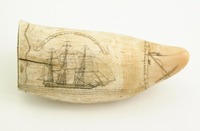 Engraved Sperm Whale Tooth 2
 A sperm whale’s tooth, engraved with a banner with an inscription over a whaleship with all sails set. The tip of the tooth is engraved with an Admiralty Pattern anchor. Reverse of the tooth depicted in “Engraved Sperm Whale Tooth 1,” “Engraved Sperm Whale Tooth 3,” and “Engraved Sperm Whale Tooth 4.” Whereas baleen was used in the manufacture of boxes, bags, trunks, canes, umbrellas, and garments such as corsets, bodices, and skirts, whale ivory and bone and walrus ivory had no commercial value and were given to the crew, who engraved or carved them during downtime. Scrimshaw was kept as a memento or gifted to loved ones upon return home. Images were not limited to scenes of whaling voyages - women, children, eagles, and buildings were popular subjects. Frederick Myrick produced 37 known carvings while serving aboard the “Susan” of Nantucket from 1826 until 1829, referred to as “Susan’s Teeth.” He was the first American whaler to sign and date his scrimshaw.
-
 Engraved Sperm Whale Tooth 1
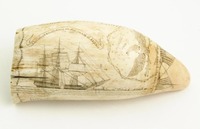
 A sperm whale’s tooth, engraved with a banner with an inscription over a whaleship with mizzen topsail, main topsail, and fore topsail set and fore sail furled. Three whaleboats surround a whale in the water in front of the ship’s bow, the boatsteerer/harpooner or boatheader of the whaleboat closest to the ship poised to strike. To the right of this scene is an eagle clutching seven arrows in its left talon and a branch in its right, a shield on its chest and a banner with an inscription in its beak, all of which are wreathed by a vine. The tip of the tooth is engraved with two crossed American flags. The obverse of the tooth depicted in “Engraved Sperm Whale Tooth 2,” “Engraved Sperm Whale Tooth 3,” and “Engraved Sperm Whale Tooth 4.” Engraved and/or carved whale teeth, baleen, walrus tusks, and whale bones are called “scrimshaw.” Whereas baleen was used in the manufacture of boxes, bags, trunks, canes, umbrellas, and garments such as corsets, bodices, and skirts, whale ivory and bone and walrus ivory had no commercial value and were given to the crew, who engraved or carved them during downtime. Scrimshaw was kept as a memento or gifted to loved ones upon return home. Images were not limited to scenes of whaling voyages: women, children, eagles, and buildings were popular subjects. Frederick Myrick produced 37 known carvings while serving aboard the “Susan” of Nantucket from 1826 until 1829, referred to as “Susan’s Teeth.” He was the first American whaler to sign and date his scrimshaw.
-
 Ship Spermo Trying With Boats Among Whales On California 1821
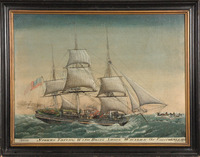
 A painting of a black whaleship in choppy water, fires burning at the front, or “fore,” and back, or “aft,” of her deck. Towards the bottom right corner, one or two whale carcasses with lances in them float in the water. In the background are two green whale boats among a pod of thrashing sperm whales. The process of rendering blubber into oil was referred to as “trying out.” Once aboard the ship, blanket pieces were further divided into “horse pieces,” about six feet long and one foot wide, and then minced into slices about an inch thick to increase surface area and speed up rendering. A minced horse piece was called “Bible leaves” due to its resemblance to a book. Bible leaves were then rendered in cast-iron pots, called “trypots,” in a brick furnace at the fore of the deck. Together, the trypots and the furnace were called “tryworks.”
-
 American Double-Flued Whaling Harpoon
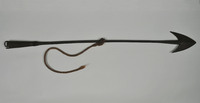
 The iron head of a harpoon, one end a flared socket where it would have been attached to a wooden shaft and one end shaped like an arrow with two barbs. This design was typical prior to the popularization of the toggle iron in the 1850s, a harpoon with a toggling head designed by Lewis Temple, an African-American blacksmith in New Bedford, Massachusetts. A length of line is tied to the shaft. Harpoons, referred to as “whale irons,” were used to attach a whaleboat to a whale. When a whaleboat got close enough to a whale, the boatsteerer would stab the animal with a harpoon tied to about 1,800 feet, or 300 “fathoms,” of line so that the boat would not be dragged down should the whale dive. The line was stored coiled in two tubs, one small and one large, and wrapped around a wooden post called a “loggerhead” at the whaleboat’s stern to slow the line as it ran out. The whaleboat was then taken on a “Nantucket sleighride” as the whale fled.
-
 Bent American Double-Flued Whaling Harpoon
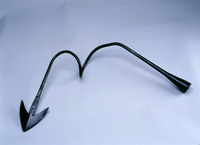
 The iron head of a harpoon, one end a flared socket where it would have been attached to a wooden shaft and one end shaped like an arrow with two barbs. There is a tight twist in the middle of the shaft. The boatsteerer was not always successful at attaching the whaleboat to the whale: the contact between a soft iron harpoon and a whale’s thick blubber could cause the harpoon to bend.
-
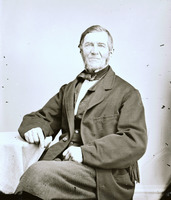 Photographic Portrait of Benjamin Lawrence
 A photograph of Benjamin Lawrence in which he is seated at a small table. Lawrence, who was born on Nantucket, served aboard the “Essex” as a boatsteerer/harpooner in first mate Owen Chase’s whaleboat on her fateful voyage. He was twenty years old. As boatsteerer/harpooner, Lawrence was responsible for pulling the oar at the bow of the whaleboat and for harpooning the whale. However, on the first hunt, three months into the “Essex”’s voyage, Lawrence, a novice boatsteerer/harpooner, hesitated to harpoon the whale that he and his crewmates in Chase’s whaleboat had rowed over a mile to reach. In that instant, another whale crushed, or “stove in,” one side of the whaleboat with its tail and both animals escaped. It is unclear whether Lawrence ever succeeded at harpooning a whale before the “Essex” reached the Offshore Ground and Chase relegated him to pulling the steering oar. When a leak was discovered in Lawrence’s, Chase’s, and Nickerson’s whaleboat a little over three weeks after the wreck of the “Essex,” it was Lawrence’s idea to repair it by tying a rope around his waist, swimming underneath the whaleboat, and holding the flat side of the blade against the loose plank so that as Chase hammered a nail from inside the whaleboat, the nail bent back into the wood. Lawrence, Chase, and Nickerson were rescued by the “Indian” of London after 91 days, on February 18, 1821.
-
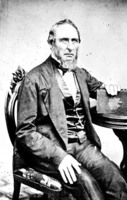 Photographic Portrait of Owen Chase
 A photograph of Owen Chase in which he is seated, his left hand resting on a box on a table beside him. Chase, who was born on Nantucket, served aboard the Essex twice before her fateful voyage: first as a sailor in 1815-1816 and then as a boatsteerer/harpooner in 1817-1819, both times under Captain Daniel Russell. Chase was promoted to first mate of the “Essex” when Russell was given command of the newly-built whaleship “Aurora” of Nantucket and Russell’s first mate, twenty-eight-year-old George Pollard, Jr., was promoted to captain of the “Essex”. Chase was twenty-one years old. As first mate, Chase was responsible for keeping the crew in line and recording information about the ship, the crew, and the hunt in the ship’s logbook. He also commanded one of the "Essex"'s whaleboats as its boatheader, with Benjamin Lawrence as his boatsteerer/harpooner and Thomas Nickerson as his after oarsman. As boatheader, he was responsible for steering the whaleboat; directing his oarsmen, whose backs were to the front, or “bow” of the whaleboat; and killing the whale when it had tired itself out. After the knockdown, Chase, along with second mate Joy, convinced Captain Pollard After the wreck of the “Essex”, Chase, again with Joy, convinced Captain Pollard to attempt to South America rather than to French Polynesia. Chase, Lawrence, and Nickerson were rescued by the “Indian” of London after 91 days, on February 18, 1821. Upon returning to Nantucket, Chase published “Narrative of the Most Extraordinary and Distressing Shipwreck of the Whale-Ship Essex.”
-
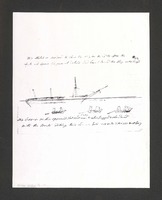 Essex on November 23 1820 at Noon
 A drawing of a whaleship without sails, rigging, or masts, most of her hull underwater. After a day and a half salvaging food, water, materials, and tools from the “Essex”, the whaleship broke apart and her crew was forced to set sail in their whaleboats, which had been modified to have higher sides, two masts (made from the “Essex”’s spars), two trapezium-like spritsails and a triangular jib (made from the “Essex”’s sails). Each boat was given two hundred pounds of dense crackers made of flour and water called “hardtack,” sixty-five gallons of fresh water, two tortoises (caught during a stop to the Galapagos Islands on the way to the Offshore Ground to collect tortoises and repair the “Essex”), a gun and gunpowder, a hatchet, a lantern, and a tinderbox. To make the bread and water last the two months they estimated it would take to reach South America, the men would have to subsist on six ounces of hardtack - about five hundred calories - and half a pint of water a day. However, only Captain George Pollard, Jr.'s and first mate Owen Chase’s boat were given a hog (purchased during a provisioning stop in Cape Verde), a compass, a quadrant, and a copy of Bowditch’s “New American Practical Navigator.” Captain Pollard’s crew included Obed Hendricks, his cousin Owen Coffin, Charles Ramsdell, Barzillai Ray, Samuel Reed, and Seth Weeks; mate Chase’s crew included Benjamin Lawrence, Thomas Nickerson, Isaac Cole, Richard Peterson, and William Wright; and mate Joy’s crew included Thomas Chappel, William Bond, Isaiah Shepherd, Charles Shorter, Lawson Thomas, and Joseph West.
-
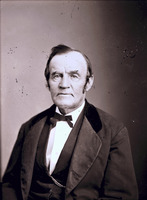 Photographic Portrait of Thomas Nickerson
 A photograph of Thomas Nickerson in which he seems to be seated. Nickerson, who was born on Cape Cod in Massachusetts and raised by his grandparents on Nantucket, served aboard the “Essex” as the cabin boy and as the after oarsman in first mate Owen Chase’s whaleboat on her fateful voyage. He was just fifteen years old. As after oarsman, Nickerson was responsible for pulling the oar at the back, or “stern,” of the whaleboat. Nickerson, Lawrence, and Chase were rescued by the “Indian” of London after 91 days, on February 18, 1821. Nickerson wrote his own account of the “Essex” in the 1870s, which was published as “The Loss of the Ship Essex Sunk by a Whale and the Ordeal of the Crew in Open Boats” in 1984.
-
 Essex at 9.30 AM November 20th
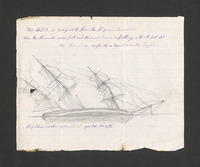
 A drawing of a whaleship with cut masts laying almost on her side, her deck facing away from the viewer. Within ten minutes of the second strike, the “Essex”’s lower decks filled with water and she capsized. However, because she sank bow-first, William Bond, the ship’s steward and one of its six Black crewmembers, was able to rescue Captain George Pollard, Jr.’s and first mate Owen Chase’s trunks, the latter of which contained a jack knife, whetstone, pencil, ten sheets of writing paper, three small fish hooks, soap, and clothing, and the navigational equipment - two compasses, two quadrants, and two copies of Nathaniel Bowditch’s “New American Practical Navigator” - from their cabins at the stern of the ship. To salvage additional supplies, Captain Pollard ordered that the ship’s rigging and masts be cut so that she could right.
-
 Essex on November 20th 1820 at 8 1/2 AM
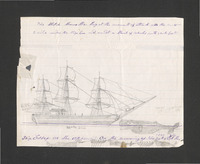
 A drawing of a sperm whale and a sailing ship, the whale’s head facing the ship’s bow. Nickerson was steering the “Essex” when the attacks occurred. The whale is estimated to have struck the “Essex” at three knots (3.4 miles per hour/5.5 kilometres per hour) the first time and between six knots (6.9 miles per hour/11.1 kilometres per hour) and nine knots (10.3 miles per hour/16.6 kilometres per hour) the second time, puncturing the ship’s bow. It is unclear which strike is depicted in Nickerson's drawing.
-
 Spermo Cutting In Whales On Japan, 1822
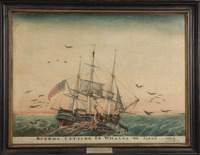
 A painting of a black whaleship in choppy water red with blood, two whale carcasses floating along the ship’s right, or “starboard,” side. A strip of blubber has been cut from the carcass closest to the ship and hangs from its rigging. The process of breaking down a whale carcass was referred to as “cutting in.” Using 15-foot-long cutting spades, a whale’s blubber was removed in strips called “blanket pieces,” each of which weighed about a ton, and hoisted onto the ship for “trying out,” rendering it into oil primarily for use in candlemaking and lamps. The ship depicted in this painting, Spermo of Nantucket, provides a reference for what Essex looked like, as she was typical of whaleships of the early 1800s.
-
 Twine
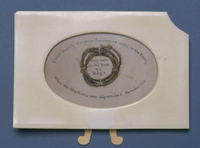
Twine A coil of twine sewn to a brown backing. The twine encircles handwritten-text and hand-written text encircles the twine. Per the inscription, Benjamin Lawrence made this twine while in the whaleboat after the wreck of the Essex. After his passing in 1879, it was given to Nantucket’s historian, Alexander Starbuck, who donated it to the Nantucket Historical Association in 1914.