American Double-Flued Whaling Harpoon
Item
-
Identifier
-
2023.0001.001
-
Title
-
American Double-Flued Whaling Harpoon
-
Creator
-
Dean & Driggs (American, established 1846)
-
Measurements
-
91.4 x 10.1 x 3.8 cm (36 x 4 x 1 1/2 inches)
-
Date Created
-
1820-1850
-
Description
-
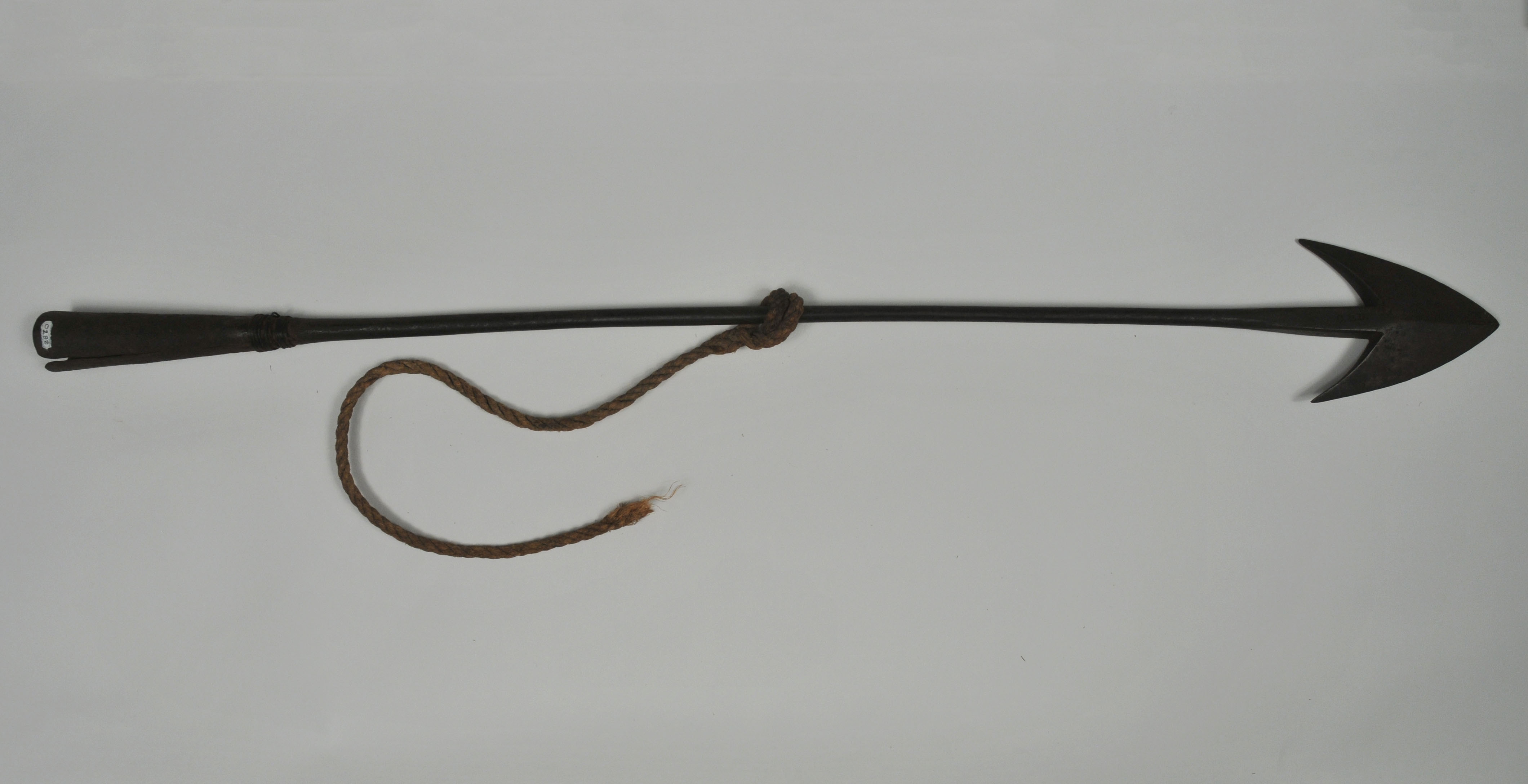
The iron head of a harpoon, one end a flared socket where it would have been attached to a wooden shaft and one end shaped like an arrow with two barbs. This design was typical prior to the popularization of the toggle iron in the 1850s, a harpoon with a toggling head designed by Lewis Temple, an African-American blacksmith in New Bedford, Massachusetts. A length of line is tied to the shaft. Harpoons, referred to as “whale irons,” were used to attach a whaleboat to a whale. When a whaleboat got close enough to a whale, the boatsteerer would stab the animal with a harpoon tied to about 1,800 feet, or 300 “fathoms,” of line so that the boat would not be dragged down should the whale dive. The line was stored coiled in two tubs, one small and one large, and wrapped around a wooden post called a “loggerhead” at the whaleboat’s stern to slow the line as it ran out. The whaleboat was then taken on a “Nantucket sleighride” as the whale fled.
-
Inscriptions
-
Stamped: D. & D.