Whaleboat
Item
-
Identifier
-
1998.1164.001
-
Title
-
Whaleboat
-
Creator
-
Unknown
-
Measurements
-
154.9 x 909.3 x 194.3 cm (5 feet 1 inches x 29 feet 10 inches x 6 feet 4 1/2 inches)
-
Date Created
-
After 1834
-
Description
-
A narrow wooden boat with black rims, or “gunwales,” and a pale blue interior. Five narrow beams, or “thwarts,” go from one side of the boat’s body, or “hull,” to the other. Three oars rest on top of the gunwales and three more rest on top of the thwarts. A rope runs the front, or “bow,” of the boat to the back, or “stern,” where it wraps around a wooden post, called a “loggerhead,” before being placed in two wooden tubs, one large with a natural finish and one small painted the same shade of blue as the boat’s interior, on the floor of the boat in a coil. Almost thirty feet long, this whaleboat is slightly larger than the “Essex”’s whaleboats, which were twenty-five feet long. A whaleboat’s crew consisted of six men: the boatheader/harpooner, who pulled the oar at the bow of the boat and harpooned the whale; the bow oarsman, who oversaw pulling on the line tied to the harpoon to bring the boat close enough to the whale for the kill; the midships oarsman; the tub oarsman, who also managed and wetted the line as it ran out; the aft oarsman, who also managed the line as it was pulled on and hauled back into the whaleboat; and the captain, first mate, or mate, who steered the whaleboat with the steering oar, directed the oarsmen, and made the kill with a lance when the whale had tired itself out. The “Essex” carried five whaleboats when she departed on her fateful voyage: three on davits on the sides of the ship so that they could be prepared and lowered in a matter of minutes when whales were sighted, a spare on an overhead rack on the ship’s deck, and a spare on davits off the ship’s stern. On the fourth day of her voyage, two of her whaleboats were lost and one was badly damaged when she suffered a “knockdown.” The “Essex” approached a squall, “a sudden violent wind often with rain or snow,” with studding sails flying. These extra sails, temporarily attached to the fore topsail yard, were used to gain additional speed in fair weather. Rather than take in the studding sails and the large main topgallant sail, Captain George Pollard, Jr. ordered that the small fore and mizzen topgallant sails be taken in. The squall hit just as the “Essex” had begun to turn away from the wind. The force of the wind hitting the ship’s side knocked her over so that she was heeled over on her left, or “port,” side by almost ninety degrees and the waist and aft larboard boats were swept away by the sea. To prevent the ship from fully capsizing, Captain Pollard ordered his crew to release the lines used to hoist the sails, or “halyards,” and the lines used to control the sails, or “sheets,” to let the sails out so they could not catch wind. However when the ship returned upright, or “righted,” she began to sail backwards, crushing the spare whaleboat off the ship’s stern. Fortunately, the “Essex” resumed course before the pressure from being forced backwards could topple her masts or break her rudder but the loss of three whaleboats could make for a financially disastrous voyage. With fewer whaleboats, a whaleship might not fill her hold with oil before returning home. Each member of a whaleship’s crew was paid a share, or “lay,” of the money earned from the sale of the oil collected during the voyage: less cargo meant less money for the crew as well as for the ship’s owners. However, Owen Chase and Matthew Joy, the “Essex”’s first and second mate, respectively, convinced him to continue the voyage, insisting that they would be able to purchase whaleboats during their first provisioning stop in the Azores.
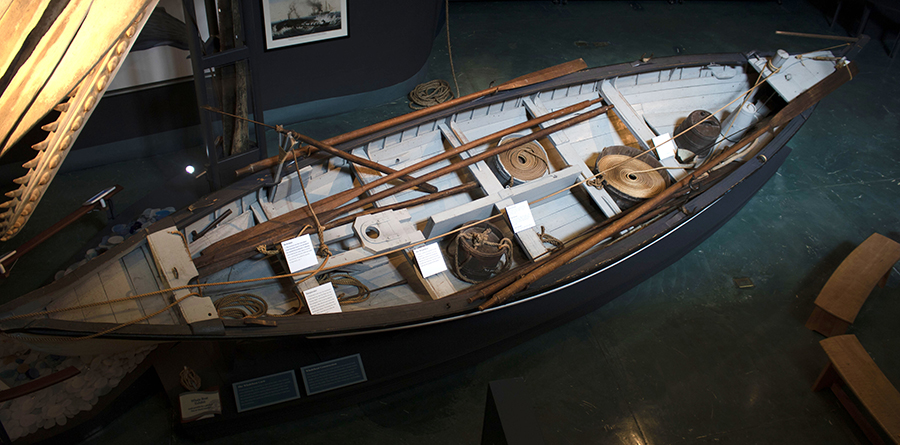
 Whaleboat