Items
1–24 of 24
Advanced search
-
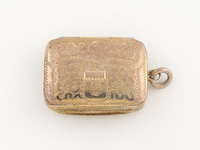 Purse-Shaped Vinaigrette This vinaigrette, a term used for small containers of perfume soaked sponges or smelling salts, features a hook for clasping onto a chatelaine.
 -
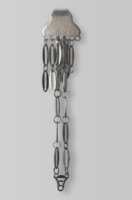 Chatelaine Hook This chatelaine hook was made for the artist's wife, Mary Allen Richardson.
 -
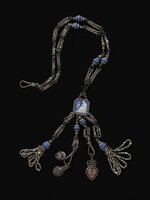
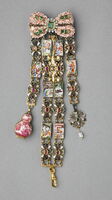 Chatelaine formed from a knot and a bracelet This chatelaine is the reunion of elements from different periods. It is formed of a knot, two bracelets made of enameled gold plates, a pendant in the shape of a dove of the Holy Spirit and a small perfume box from the years 1640-1660, mounted with a large hook, a small hook for attaching the watch and end elements from the 19th century.
 -
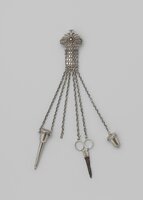
 A Silver Chatelaine with Queen-Stitch Pin Ball Chatelaine hook engraved with the initials "S.C.P.", with a silver-banded Queen-stitch pin ball and pair of scissors.
 -
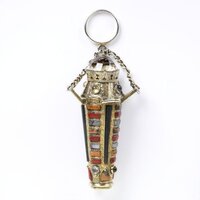 Vinaigrette This vinaigrette was made by the Edinburgh jeweller, G&M Crichton who exhibited jewellery at the London Exhibition of 1872.
 -
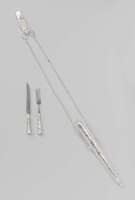 Knife and Fork for Chatelaine Knife and fork with silver handle. Tube lid, silver, with engraved flower tendrils. Attached to a chatelaine with a chain.
 -
 Chatelaine This chatelaine was greatly admired by the exhibition jury and won a Prize Medal. Their report commented: “ a beautiful chatelaine, entirely of wrought steel: it is composed of twelve pieces, adjusted with extreme care, and covered with faceted ornaments; several of the pieces, such as the étui, the key, the tablets and the almanack, have required very long and skilful work and twelve months were required to complete this chatelaine. It was made entirely in London, and not a single piece of it was stamped.”
 -
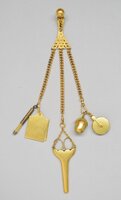
 Chatelaine This chatelaine holds a pair of scissors (the upper part of the legs with silver sirats), a heart-shaped pincushion covered with red flowered silk, as well as a medallion-shaped object (probably for a magnifying glass - the middle part is missing).
 -
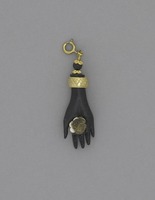 Chatelaine Piece, Hand Charm for chatelaine in the form of a small black hand with gold bracelet. The hand holds a small gold flower in its palm. This is most likely a piece of mourning jewelry. The hand is often a mourning symbol in victorian jewelry in memory of husband or sweetheart.
 -
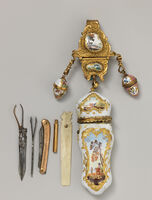 Etui and Chatelaine Étuis and châtelaines were sold alongside other luxurious trinkets, known as "toys," through which wealth and taste could be displayed. Some toys were functional, intended to store foodstuffs, cosmetic products, or snuff; others were intended for no purpose other than to delight. Some were made of precious metals, like gold or silver, and were sold at correspondingly high prices; others employed relatively inexpensive materials and were thus available to the expanding middle classes.
 -
 Chatelaine The top part of the chatelaine has a long hook at the back by which it would have hung from the belt of a fashionable lady. The chatelaine has London hallmarks on the hook, so it can be dated precisely to 1755-6. There are three objects suspended from the chatelaine. In the middle is a watch, which bears the name of the watchmaker, Robert Cawley, Chester, movement no. 91. The watch and the small empty container or étui on the right are of approximately the same date as the chatelaine. To the left is a container or étui for snuff, which dates from about 1730. It contains a small gold spoon for ladling out the snuff and a 19th century watch key. The chatelaine and the watchcase are decorated with figure scenes. On the chatelaine there are scenes from the life of King David as described in the Bible. On the watchcase is a scene of Angelica and Medoro carving their initials in a tree, taken from the epic Orlando Furioso by the Italian poet Ludovico Ariosto (1474-1533).
 -
 Chatelaine This woman’s chatelaine set consists of earscoops, nail cleaners, tweezers and a brush. Chatelaines like this are normally hung from the left shoulder and worn with a full set of jewellery and ornaments at festival times by the women of Ladakh, on the western edge of the Tibetan plateau.
 -
 Chatelaine Steel chatelaine with coloured gold decoration
 -
 Chatelaine The main element of this chatelaine is an étui, a container fitted with a penknife, a bodkin for threading ribbon through lace, a combined nail-file and tweezers, and a combined toothpick and earscoop. Because these items are a selection from a fairly standard list of étui equipment, it is possible to tell from the shape of the remaining empty slot that this étui once also contained a hinged pair of ivory memorandum leaves (these could be written on, using a pencil). The small egg-shaped screw-top containers known as breloques may have been for small breath-freshening sweets. Chatelaines were not just attractive ornaments for ladies; their contents were useful too, and not unlike today's manicure sets, sewing kits and Swiss army knives. Mid-18th-century chatelaines were usually made from gilt metal, an alloy such as pinchbeck, or silver and gold. They were often ornately embossed with Rococo scrolling and sometimes had mother of pearl or agate panels. Enamelled chatelaines are comparatively unusual. They were quite complex to assemble, and few West Midlands workshops, except enterprises as large as that of Boulton & Fothergill of Birmingham, were capable of producing all the components, including mounts and enamelled parts. This is therefore the product of a larger factory, or if from a small workshop, a composite of parts bought in.
 -
 Chatelaine Chatelaine, Singer Manufacturing Co., owned by Ethel Griffies and possibly used by her on stage.
 -
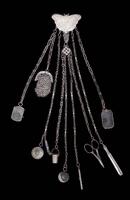 Chatelaine A cut steel chatelaine with face of hook in shape of bat, nine pendants of varying length, holding a chain purse, a pin box (?) or needle box lined with blue velvet, a pin case (at one end of a double chain, other piece missing), a thimble case in shape of bucket, stylus, a pair of embroidery scissors, a knife, and a note book with ivory leaves, on one leaf a pencilled note still remains.
 -
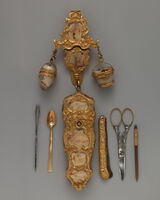 Chatelaine Chatelaines, which hung from the waist, were designed to hold sewing, writing, or toilet implements.


1–24 of 24