Skip to main content
Resource Template
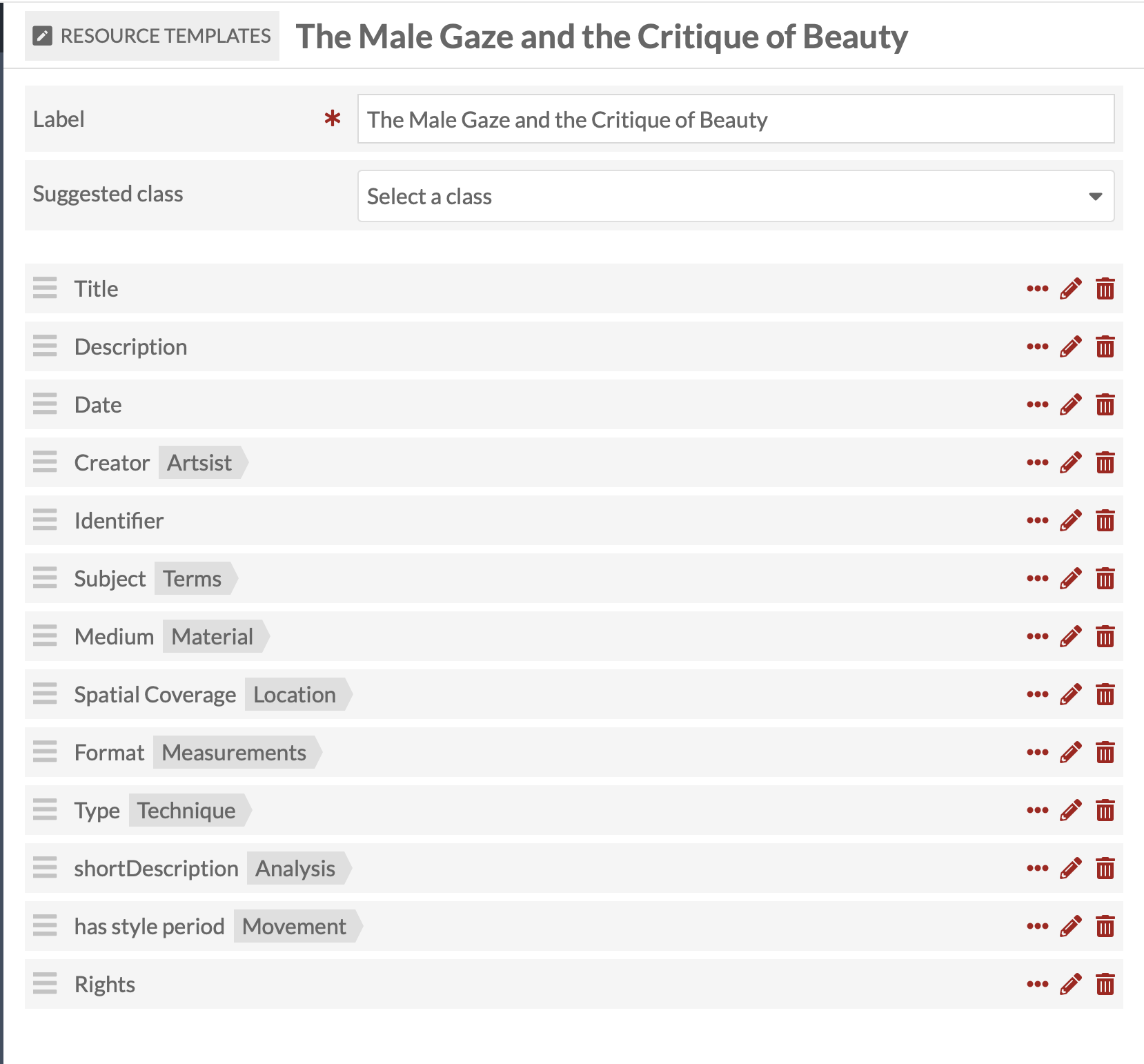
In my resource template, I focused on key identifying elements to keep cataloging accurate while leaving room for interpretation. I made the Subject (terms) and Type (technique) fields repeatable because many artworks deal with several themes, such as the gaze, the nude, and artistic authorship. This choice recognizes that these works cannot fit into just one category and need multiple ways to be described. I also added a custom “Analysis” field, using a bibliographic ontology to include a brief critical interpretation in the metadata. I did this on purpose, since the project examines the male gaze, and I wanted the metadata to encourage theoretical discussion instead of just offering a neutral description.
The template is built from a combination of Dublin Core, VRA Core, and Bibliographic Ontologystandards. Dublin Core provides the foundational structure—fields such as Title, Creator, Date, Description, Subject, and Identifier—ensuring interoperability and compatibility within a broader linked data environment. Because the collection focuses on visual artworks, I incorporated VRA Core to allow for more precise art historical description, including fields like Style/Period and Work Type. Additionally, I used controlled vocabularies such as the Getty AAT and ULAN to standardize descriptive terms and establish a consistent framework for artists, materials, and cultural objects.
When I created the template, I decided which fields should be repeatable or not based on cataloging standards and how people use the data. Fields like Title, Creator, and Date are non-repeatable because they define the main identity of each object and only need to appear once. Fields like Subject and Type are repeatable, so they can have several entries. This shows the complexity of each artwork and makes them easier to search. This setup supports different ways of researching and lets users explore the collection by different themes and ideas.
Overall, the combination of standardized metadata frameworks. By using controlled vocabularies it helps keep the template consistent and integrated with other systems. Adding the Analysis field lets each record take part in the project’s main critique. This means the metadata is both descriptive and interpretive, supporting the larger goal of examining and challenging the male gaze.